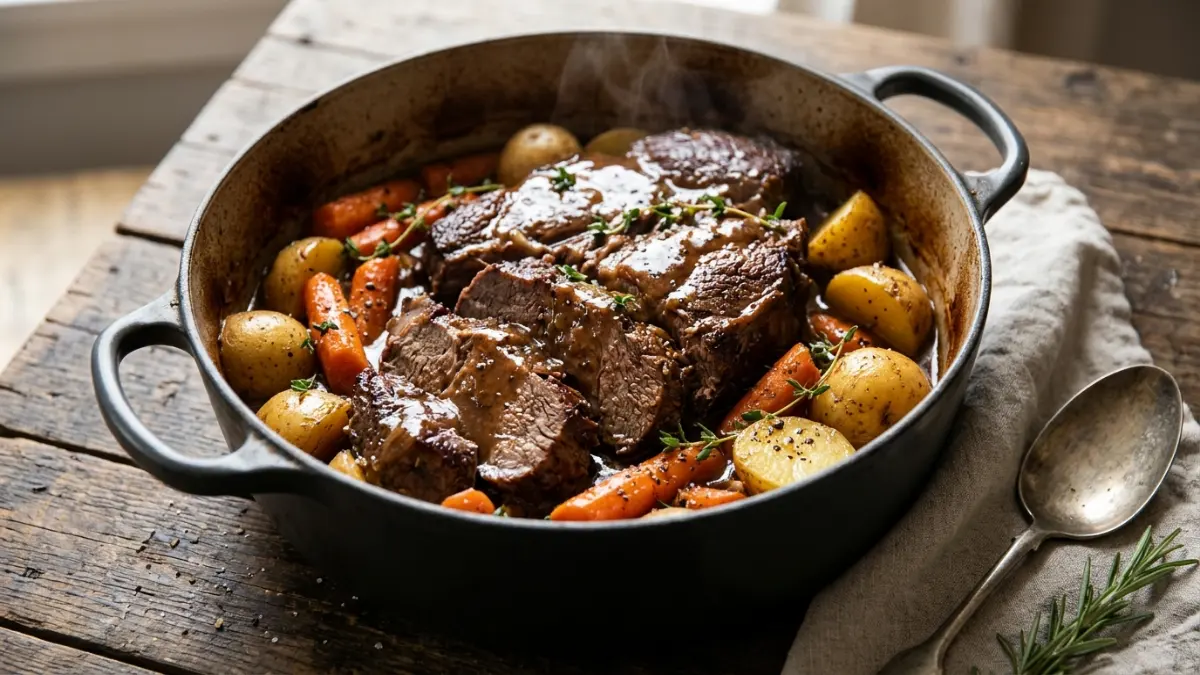
A classic pot roast combines a well-marbled cut of beef chuck with aromatic aromatics, dry red wine, beef stock, and tender root vegetables, braised slowly in a heavy Dutch oven until fork-tender.
The prolonged low-temperature braise breaks down tough connective tissue into rich gelatin, yielding distinct, sliceable-yet-tender meat and a glossy, full-bodied sauce. This traditional one-pot method offers deep flavor through thorough surface browning, balanced braising liquid, and staggered cooking so the vegetables stay intact rather than turning mushy.
Recipe Testing Status: This base recipe is an untested editorial proposal designed using standard braising mechanics and culinary proportions. It has not yet undergone formal kitchen verification by our editorial team. Times, liquid reduction rates, and seasoning levels should be monitored closely in your kitchen.
Classic Beef Pot Roast
A complete, slow-simmered Sunday dinner featuring fork-tender chuck roast, creamy baby potatoes, sweet carrots, and a savory pan sauce flavored with fresh rosemary and thyme.
- Yield: 6 servings
- Serving Size: Approximately 5 to 6 ounces cooked beef with 1 cup vegetables and 1/4 cup sauce
- Prep Time: 25 minutes
- Cook Time: 3 hours 30 minutes
- Resting Time: 15 minutes
- Total Elapsed Time: 4 hours 10 minutes
- Essential Equipment: 6- to 8-quart enameled cast-iron Dutch oven with a tight-fitting lid, kitchen tongs, instant-read thermometer, paper towels
Ingredients
Beef and Searing
- 1 boneless beef chuck roast (3 1/2 to 4 pounds), trimmed of excess surface fat over 1/4-inch thick, patted dry
- 2 teaspoons kosher salt (Diamond Crystal; or 1 1/2 teaspoons Morton kosher salt), divided
- 1 teaspoon freshly ground black pepper
- 2 tablespoons neutral high-smoke-point oil (such as avocado oil or vegetable oil)
Aromatics and Deglazing
- 1 large yellow onion, peeled, halved, and cut into 1/2-inch wedges
- 2 medium ribs celery, trimmed and cut into 1-inch pieces
- 4 cloves garlic, peeled and smashed
- 1 1/2 tablespoons tomato paste
- 2 tablespoons all-purpose flour
- 1 cup dry red wine (such as Cabernet Sauvignon or Pinot Noir; or substitute an equal amount of unsalted beef broth)
- 2 cups unsalted beef broth (or unsalted beef bone broth)
- 1 tablespoon Worcestershire sauce
- 3 fresh thyme sprigs
- 2 fresh rosemary sprigs
- 2 dried bay leaves
Braised Vegetables
- 1 pound baby yellow potatoes (such as Yukon Gold), washed and halved (leave small 1-inch potatoes whole)
- 1 pound large carrots, peeled and cut diagonally into 1 1/2-inch chunks
Instructions
Preparation and Searing
- Preheat the oven and prepare the beef:Position a rack in the lower third of the oven and preheat to 300°F (150°C). Thoroughly pat the chuck roast dry with paper towels on all sides. Season evenly with 1 1/2 teaspoons of the kosher salt and 1 teaspoon of black pepper, pressing the seasoning into the surface of the meat.
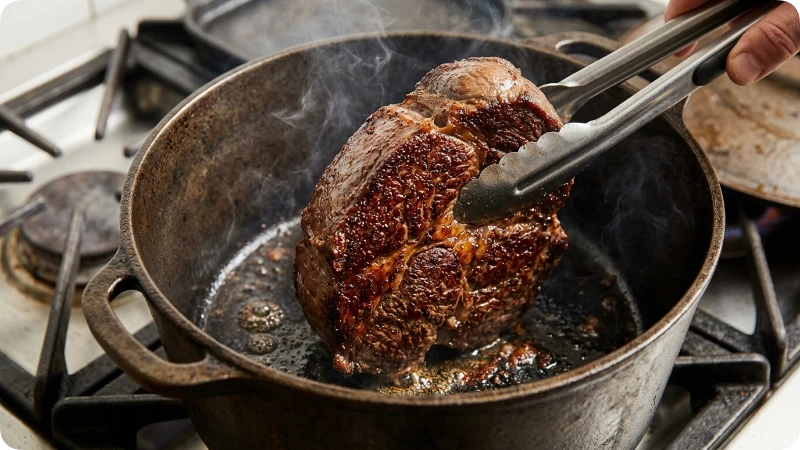
- Sear the meat thoroughly:Heat 2 tablespoons of neutral oil in a 6- to 8-quart heavy Dutch oven over medium-high heat until shimmering, but not smoking (about 2 to 3 minutes). Carefully lower the seasoned beef into the pot. Sear without moving for 5 to 6 minutes, until a deep golden-brown crust forms. Using tongs, rotate the roast and brown the reverse side for 5 minutes. Sear the narrow sides for 1 to 2 minutes each, holding the meat upright with tongs if needed. Transfer the seared roast to a large plate or rimmed sheet; set aside. Turn the stovetop heat down to medium.
Building the Base and Braising
- Cook the aromatics:Add the sliced onion and celery to the residual fat in the Dutch oven. Cook for 4 to 5 minutes, stirring occasionally with a flat wooden spoon, until the onions are softened and lightly browned on the edges. Add the smashed garlic and cook for 1 minute until fragrant. Add 1 1/2 tablespoons of tomato paste, stirring constantly for 1 to 2 minutes until the paste darkens to a brick-red color. Sprinkle 2 tablespoons of all-purpose flour over the vegetables and stir continuously for 1 minute to eliminate raw flour flavor.
- Deglaze the pot:Pour in 1 cup of dry red wine, scraping the bottom and sides of the pot with the wooden spoon to dislodge all browned fond. Bring the liquid to a steady simmer and cook for 3 to 4 minutes, allowing the wine to reduce by approximately half.
- Build the braising base:Stir in 2 cups of unsalted beef broth, 1 tablespoon of Worcestershire sauce, and the remaining 1/2 teaspoon of kosher salt. Tie the thyme and rosemary sprigs together with kitchen twine (or drop them in whole) and add them along with the bay leaves. Bring the braising liquid to a gentle simmer.
- Begin the braise:Return the seared chuck roast and any accumulated resting juices to the pot. The braising liquid should come one-third to halfway up the side of the meat; it should not submerge the roast. Cover the Dutch oven with its tight-fitting lid, transfer to the preheated oven, and braise at 300°F for 2 hours.
Adding Vegetables, Resting, and Serving
- Add the root vegetables:Carefully remove the Dutch oven from the oven. Uncover the pot. Arrange the halved potatoes and sliced carrots around and partially beneath the beef, submerging them as much as possible in the braising liquid. Replace the lid, return the pot to the oven, and continue braising until the beef is tender enough that a two-pronged fork slides into the center and twists with no resistance, about 1 hour to 1 hour and 15 minutes longer. (Internal meat temperature should register between 195°F and 203°F on an instant-read thermometer).
- Rest and finish the sauce:Transfer the beef to a carving board or serving platter and tent loosely with aluminum foil; let rest for 15 minutes. Using a slotted spoon, transfer the carrots and potatoes to a serving dish. Discard the thyme stems, rosemary sprigs, and bay leaves. Skim excess surface fat from the liquid in the pot using a wide spoon or fat separator. If a thicker sauce is desired, place the Dutch oven on the stovetop over medium heat and simmer for 5 to 8 minutes until reduced to a light, coating consistency. Taste the sauce and adjust with additional salt and pepper if desired.
- Carve and serve:Slice the beef across the grain into 1/2-inch thick slices, or break it gently into large serving pieces along natural muscle seams. Serve warm surrounded by the potatoes and carrots, with the warm pan sauce spooned generously over the top.
Ingredient Notes and Substitutions
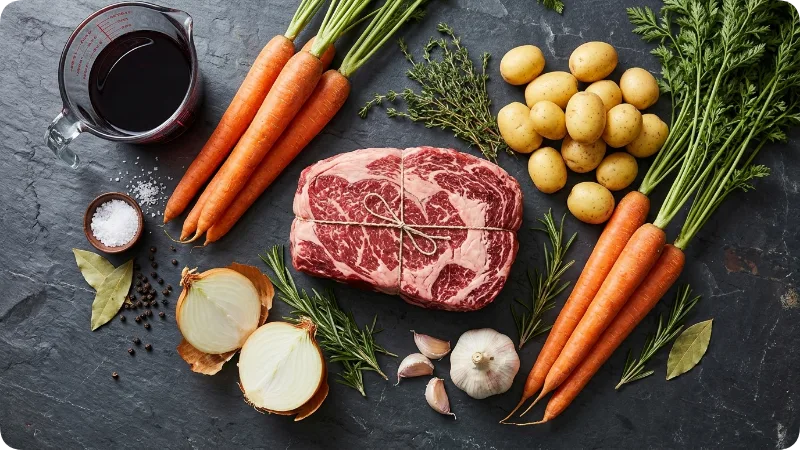
- Beef Chuck Roast: Boneless beef chuck roast (cut from the shoulder) contains the highest proportion of intramuscular fat and collagen among standard braising cuts. Lean cuts like bottom round, eye of round, or sirloin tip dry out during long braises. If beef chuck roast is unavailable, bone-in chuck roast, beef shank, or bone-in beef short ribs are functional alternatives; adjust cooking weights up by 25 to 30 percent to account for bone waste.
- Dry Red Wine: An acidic, dry red wine (such as Cabernet Sauvignon, Merlot, or Côtes du Rhône) cuts through the richness of the rendered beef fat and helps balance the gelatinous sauce. If cooking without alcohol, replace the 1 cup of red wine with an equal volume (1 cup) of unsalted beef broth plus 1 tablespoon of red wine vinegar or balsamic vinegar to maintain proper acidity.
- Tomato Paste: Concentrated tomato paste provides acid, umami (natural glutamates), and pectin, helping build color and light body in the sauce. Do not substitute tomato sauce or crushed canned tomatoes without reducing the broth volume by an equivalent amount.
- Potatoes: Low-to-medium starch potatoes, such as small Yukon Golds or red bliss potatoes, maintain their structural shape during an hour of braising. High-starch Russet potatoes will absorb liquid too quickly, break apart, and turn mealy in the sauce.
- Carrots: Standard large carrots hold their shape better than slender baby-cut packaged carrots. Cut them into substantial 1 1/2-inch pieces so they finish cooking at the same time as the potatoes.
Before You Begin: Equipment and Prep
- Select the Right Cookware: A 6- to 8-quart heavy enameled cast-iron Dutch oven is required for even heat retention and moisture control. A lightweight stockpot or thin stainless pan dissipates heat unevenly, increasing the risk of scorching the bottom aromatics.
- Moisture Removal: Water on the surface of raw meat converts to steam when it hits hot oil, lowering the pan temperature and preventing the Maillard reaction. Pat the roast dry with paper towels until the exterior feels completely matte before seasoning.
- Oven Rack Height: Adjust your oven rack to the lower-third position before turning on the oven. A lidded Dutch oven is tall; placing it on the center rack can put the lid too close to the upper heating elements, leading to hot spots.
How to Make Pot Roast: Key Steps and Checkpoints
1. Achieving a Deep Maillard Sear
Browning the beef is not intended to “seal in juices” a disproven culinary myth but to generate hundreds of new flavor compounds via the Maillard reaction.
Take your time during this step. Use medium-high heat and do not move the roast for the first 5 minutes. The meat should release naturally from the cast iron once a structured, mahogany crust forms. If the meat resists when you gently lift it with tongs, allow it another minute to release cleanly.
2. Deglazing the Fond
After sautéing the onions, celery, garlic, and tomato paste, a dark glaze (fond) will coat the base of the Dutch oven.
Pouring the wine into the hot pan instantly releases steam and lifts this concentrated flavor base. Scrape vigorously with a flat-edged wooden spoon until the metal or enamel floor is completely smooth. Leaving the fond stuck to the bottom risks scorching during the multi-hour oven braise.
Sear Chuck Roast → Sauté Aromatics → Toast Tomato Paste & Flour → Deglaze with Wine → Add Broth & Herbs → Braise (2 Hours) → Add Root Vegetables → Braise (1 to 1.25 Hours) → Rest & Defat Sauce
3. The Two-Stage Vegetable Addition
A frequent defect in one-pot roast recipes is overcooked, mushy vegetables.
Root vegetables require only 50 to 70 minutes at 300°F to reach tender doneness. Adding the carrots and potatoes at the very beginning of a 3.5-hour braise causes their cell walls to fully collapse, disintegrating them into the gravy.
Introducing them at the 2-hour mark ensures that the beef reaches tenderness at the exact moment the potatoes turn creamy and the carrots become tender-crisp.
Troubleshooting Common Issues
- Problem: The beef is tough, dry, or chewy.
- Cause: The meat is undercooked. Collagen fibers require sustained heat (above 180°F) over several hours to denature into soft gelatin. An undercooked chuck roast retains rigid muscle fibers.
- Prevention: Ensure the oven maintains 300°F and the braising liquid simmers gently.
- Safe Fix: Return the covered pot to the oven for an additional 30 to 45 minutes, testing every 15 minutes with a fork until the meat yields easily.
- Problem: The sauce tastes flat, heavy, or overly greasy.
- Cause: Excess beef tallow remained in the pan, or the liquid lacks acidity to balance the richness.
- Prevention: Trim fat caps thicker than 1/4 inch before searing; skim surface fat thoroughly after cooking.
- Safe Fix: Skim surface oil with a ladle or transfer the sauce through a fat separator. Stir in 1/2 teaspoon of red wine vinegar or fresh lemon juice just before serving to brighten the profile.
- Problem: The vegetables are mushy and falling apart.
- Cause: Vegetables were cut too small or introduced too early in the cooking process.
- Prevention: Cut carrots and potatoes into dense pieces no smaller than 1 1/2 inches, and wait until the 2-hour mark to add them.
- Safe Fix: Remove the collapsed vegetables carefully with a slotted spoon to prevent them from clouding the sauce further; their texture cannot be restored once overcooked.
Alternative Cooking Methods
Slow Cooker (Crock-Pot) Conversion
- Season and sear the chuck roast in a skillet on the stovetop as directed in Step 2. Sauté the aromatics, tomato paste, and flour; deglaze with wine.
- Transfer the sautéed mixture and seared roast to a 6-quart slow cooker.
- Reduce total liquid: use only 1 1/4 cups unsalted beef broth (slow cookers do not allow steam evaporation).
- Place carrots and halved potatoes around the meat from the beginning if cooking on Low for 8 to 9 hours, or add them halfway through if cooking on High for 5 to 6 hours. Cook until fork-tender.
Electric Pressure Cooker (Instant Pot) Conversion
- Using the “Sauté” function on High, sear the seasoned roast on all sides in oil; remove to a plate.
- Sauté aromatics, tomato paste, and flour; deglaze with 1/2 cup dry red wine, scraping the bottom thoroughly to avoid a “Burn” notice.
- Stir in 1 1/2 cups unsalted beef broth, herbs, and Worcestershire sauce. Return the roast to the pot.
- Seal the lid, set to High Pressure, and cook for 45 minutes. Allow a 15-minute Natural Pressure Release (NPR), then vent remaining steam.
- Add the carrots and potatoes. Reseal the lid and cook on High Pressure for an additional 5 minutes, followed by a quick pressure release.
Serving Suggestions
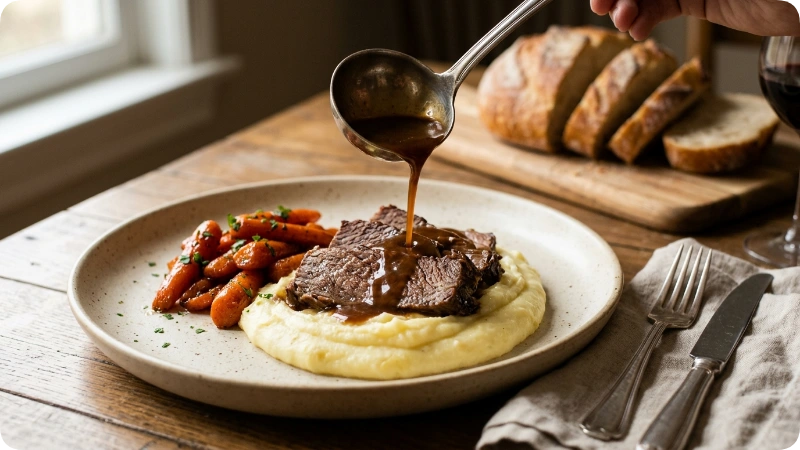
- Creamy Polenta or Mashed Potatoes: If omitting the braised potatoes from the pot, serve the shredded or sliced beef over warm, buttered Yukon Gold mashed potatoes or soft mascarpone polenta to catch the pan sauce.
- Crusty Sourdough Bread: Serve with thick slices of warm artisan sourdough or French baguette to absorb the reduced braising juices.
- Bright Side Salad: Pair with a crisp, bitter green salad (arugula, radicchio, or shaved fennel) tossed in a sharp lemon-dijon vinaigrette to contrast the deep savoriness of the braised beef.
Make-Ahead, Storage, and Reheating
- Make-Ahead Advantage: Braised pot roast improves in flavor and texture when prepared 24 hours in advance. Chilling allows the rendered beef tallow to solidify into a firm white cap on the surface of the liquid, which can be lifted off and discarded cleanly before reheating.
- Refrigeration: Store cooled leftover beef, vegetables, and sauce together in an airtight glass or plastic container in the refrigerator for up to 4 days. Keep the meat submerged in sauce to prevent surface drying.
- Reheating on the Stovetop: Place the meat, vegetables, and sauce in a covered saucepan over medium-low heat. Heat gently for 15 to 20 minutes until the internal temperature of the beef reaches at least 165°F (74°C) as verified by an instant-read thermometer.
- Reheating in the Oven: Place contents into an oven-safe baking dish, cover tightly with foil to lock in steam, and warm at 325°F (165°C) for 20 to 25 minutes until steaming throughout.
- Freezing: Pot roast freezes well for up to 3 months. Freeze the sliced or shredded beef completely submerged in its sauce in freezer-safe bags or containers. Note on Vegetables: Braised potatoes and carrots become watery and mealy upon thawing; for best results, freeze the beef and sauce separately, then cook fresh vegetables when reheating.
Nutritional Estimates
Nutritional values are rough estimates calculated per serving (1/6 of recipe, including beef, vegetables, and skimmed sauce) using standard USDA food database references for trimmed beef chuck and root vegetables. Assumes 2 tablespoons of surface fat are removed after braising.
- Calories: 540 kcal
- Protein: 52 g
- Total Fat: 22 g
- Saturated Fat: 8 g
- Carbohydrates: 28 g
- Dietary Fiber: 4 g
- Sugars: 5 g
- Sodium: 680 mg
FAQs
What is the best cut of beef for pot roast?
Boneless or bone-in beef chuck roast is the premier choice. Sourced from the animal’s shoulder, chuck contains abundant marbling and connective collagen that melts into gelatin during low, slow cooking. Leaner cuts such as round, rump, or sirloin tip lack adequate fat and collagen, resulting in dry, stringy meat when braised.
Why is my pot roast tough after 3 hours?
If your roast is tough after 3 hours, it is almost always undercooked rather than overcooked. Muscle fibers initially contract and squeeze out water around 140°F to 160°F; the meat remains tough until internal temperatures stay between 195°F and 203°F long enough for collagen to dissolve. Put the lid back on and continue braising in 20-minute increments until a fork twists freely.
Can I make pot roast without wine?
Yes. Substitute the 1 cup of dry red wine with an equal volume (1 cup) of unsalted beef broth combined with 1 tablespoon of red wine vinegar or Worcestershire sauce. The acid is necessary to balance the richness of the rendered beef fat.
Should the meat be completely submerged in liquid?
No. Pot roast is a braise, not a boil or stew. The braising liquid should reach only one-third to halfway up the sides of the beef. Submerging the meat washes out surface flavors and prevents the upper exposed portion from concentrating flavor as it cooks in the moist, enclosed steam.
How do I thicken the pot roast gravy?
If the braising juices are too thin after cooking, remove the beef and vegetables, and simmer the liquid uncovered on the stovetop over medium-high heat for 8 to 10 minutes to reduce it naturally. Alternatively, whisk 1 tablespoon of cornstarch with 1 tablespoon of cold water to form a slurry, stir it into the simmering liquid, and cook for 1 to 2 minutes until thickened and glossy.
Article Summary
This comprehensive guide details the preparation of a traditional, oven-braised beef pot roast, engineered to deliver tender meat, balanced sauce, and structured root vegetables. Built around a 3 1/2- to 4-pound boneless beef chuck roast, the method uses a heavy cast-iron Dutch oven to maintain an even, low-temperature cooking environment at 300°F.
The process begins with aggressive surface searing to trigger the Maillard reaction, generating deep savory notes and establishing a concentrated fond. Sautéed yellow onions, celery, garlic, tomato paste, and a dusting of flour are deglazed with dry red wine, creating an emulsified braising liquid alongside unsalted beef stock, fresh thyme, and rosemary.

Leo Campbell is the founder, recipe developer, and culinary voice behind Recipe Morsil. With nearly a decade of hands-on home cooking and professional baking experience, Leo tests every recipe multiple times to ensure reliable, fail-proof results in real home kitchens. When he’s not fine-tuning spices or testing cook times, he’s helping home cooks build confidence one bite at a time.
Connect with Leo via [Instagram/Email] or explore his verified recipes below.