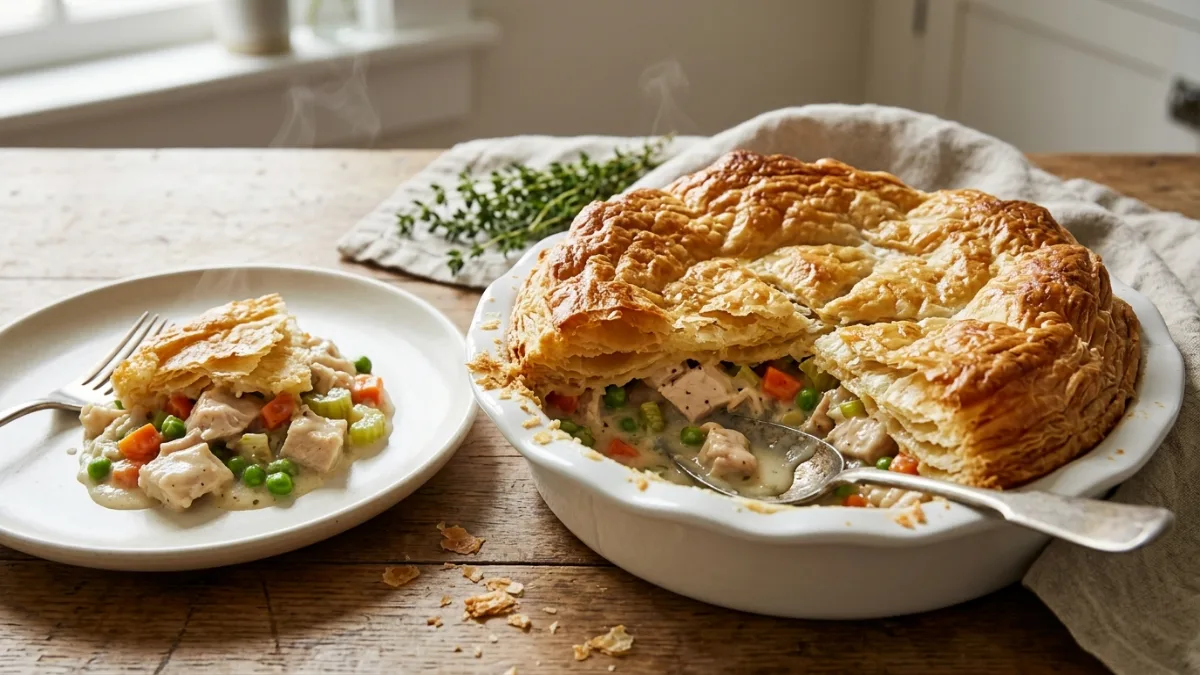
This chicken pot pie recipe with puff pastry swaps out traditional double crusts for a sheet of crisp, layered pastry over a savory, herb-infused chicken and vegetable Velvety. The result delivers the rich, classic flavor of homemade pot pie with an exceptionally flaky, golden top crust. Because puff pastry bakes quickly and lifts reliably over a pre-warmed filling, this single-crust approach provides maximum texture contrast with minimal hands-on prep.
Recipe Testing Disclosure: This recipe is an untested proposal developed from standard professional culinary ratios and commercial baking parameters; it has not yet been physically validated in a test kitchen. Review individual baking cues and internal temperatures carefully during preparation.
Chicken Pot Pie with Puff Pastry
Yield: 6 servings (approx. 1 1/3 cups filling plus pastry per portion)
Prep Time: 25 minutes
Cook Time: 45 minutes
Inactive Time: 40 minutes (thawing pastry and cooling filling)
Total Elapsed Time: 1 hour 50 minutes
Essential Equipment: 10-inch deep-dish pie plate or 2-quart baking dish (approx. 8×8 or 9×9 inches, at least 2 inches deep), rimmed baking sheet, 4-quart saucepan or Dutch oven, rolling pin, pastry brush, instant-read food thermometer.
Ingredients
For the Filling:
- 4 tablespoons (2 oz / 57 g) unsalted butter
- 1 medium yellow onion, diced (about 1 1/2 cups / 200 g)
- 2 medium carrots, peeled and sliced into 1/4-inch rounds (about 1 cup / 130 g)
- 2 medium celery ribs, sliced into 1/4-inch pieces (about 3/4 cup / 100 g)
- 8 oz (227 g) cremini or white button mushrooms, sliced 1/4-inch thick (optional)
- 2 cloves garlic, finely minced
- 1/3 cup (1.5 oz / 42 g) all-purpose flour
- 2 cups (480 ml) low-sodium chicken broth, warm
- 1/2 cup (120 ml) heavy cream, room temperature
- 1 teaspoon kosher salt (Diamond Crystal; use 3/4 teaspoon for Morton)
- 1/2 teaspoon freshly ground black pepper
- 1 teaspoon fresh thyme leaves (or 1/3 teaspoon dried thyme)
- 1/2 teaspoon finely chopped fresh rosemary
- 3 cups (approx. 1 lb / 450 g) cooked chicken breast or thigh meat, shredded or cut into 1/2-inch cubes
- 1 cup (140 g) frozen sweet peas, unthawed
For the Crust:
- 1 sheet (approx. 14 oz / 397 g to 17.3 oz / 490 g package) frozen puff pastry, thawed in the refrigerator
- 1 large egg
- 1 tablespoon cold water
- Flaky sea salt, for sprinkling (optional)
Instructions
Prep & Pastry Thawing
- Thaw and prepare the puff pastry: Place the folded sheet of frozen puff pastry in the refrigerator for at least 3 to 4 hours (or overnight) until pliable but chilled throughout.
- Preheat oven and prep pan: Position an oven rack in the middle position. Preheat the oven to 400°F (204°C). Place your empty 2-quart baking dish on a rimmed baking sheet lined with foil or parchment paper to catch drips.
Make the Velvety Filling
- Soften the vegetables: Melt the butter in a 4-quart saucepan or Dutch oven over medium heat. Add the diced onion, carrots, and celery (and mushrooms, if using). Cook for 8 to 10 minutes, stirring occasionally, until the onions are translucent and the carrots begin to soften. Stir in the minced garlic and cook for 1 minute until fragrant.
- Build the roux: Sprinkle the all-purpose flour evenly over the vegetables. Stir constantly for 2 minutes to cook out the raw flour taste. The mixture will coat the vegetables and look like a thick paste.
- Form the sauce: Slowly pour in the chicken broth in a thin, steady stream while whisking or stirring constantly to dissolve any flour paste from the bottom of the pan. Stir in the heavy cream, kosher salt, black pepper, thyme, and rosemary.
- Simmer to thicken: Bring the mixture to a gentle boil over medium heat, stirring frequently. Reduce the heat to medium-low and simmer for 3 to 5 minutes until the sauce coats the back of a spoon cleanly.
- Incorporate chicken and peas: Stir in the cooked chicken and frozen peas. Remove the pan from heat. Taste the sauce and adjust salt and pepper if desired. Allow the filling to cool in the pan for 10 to 15 minutes. It should be warm, not boiling hot, before adding the crust.
Assemble, Bake & Rest
- Roll and trim the pastry: On a lightly floured work surface, roll the thawed puff pastry sheet into a shape roughly 1 inch wider than the perimeter of your baking dish (approx. 1/8-inch thickness).
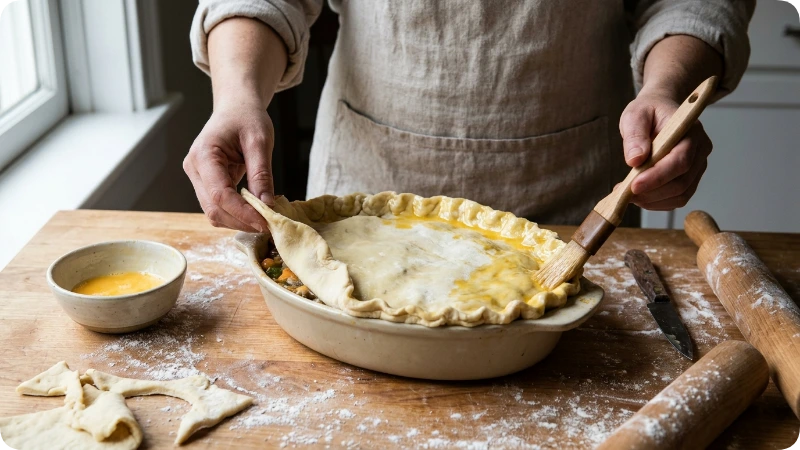
- Assemble the pie: Transfer the warm filling into the 2-quart baking dish. Beat the egg with 1 tablespoon of cold water in a small bowl. Brush the top outer rim of the baking dish with a thin film of the egg wash to act as an adhesive.
- Apply the crust: Carefully drape the pastry over the filling. Press the overhang gently against the moistened rim of the dish to anchor it. Crimp or trim excess dough with kitchen shears, leaving roughly 1/2-inch overhang.
- Vent and glaze: Cut 3 to 4 slits (each about 1 to 2 inches long) in the center of the pastry with a sharp paring knife to allow steam to escape. Lightly brush the surface of the pastry with egg wash, avoiding dripping excess wash down the cut edges (which can seal pastry layers). Sprinkle lightly with flaky sea salt if desired.
- Bake: Transfer the baking sheet holding the pie dish to the middle rack of the oven. Bake at 400°F (204°C) for 25 to 30 minutes, until the puff pastry is deep golden brown, risen, and the filling visibly bubbles through the steam vents. Verify with an instant-read thermometer inserted into the center of the filling that the temperature reaches at least 165°F (74°C).
- Rest and serve: Remove the dish from the oven and set it on a wire rack to rest for 10 to 15 minutes before serving. This allows the hot sauce to stabilize and set slightly for clean scooping.
Ingredient Notes and Substitutions
- Puff Pastry: All-butter puff pastry offers distinct flavor and tenderness, while vegetable shortening-based pastry often delivers taller structural lift. Thaw only in the refrigerator; warm ambient room thawing softens the fat layers prematurely, causing grease leakage and preventing expansion.
- Cooked Chicken: Roasted rotisserie chicken (skin discarded, meat shredded) saves time and brings deep roasted notes. Poached boneless chicken breasts or cooked leftover turkey work equally well. Ensure pre-cooked poultry remains refrigerated at or below 40°F (4°C) until added to the warm sauce.
- Chicken Broth: Use low-sodium commercial stock or unseasoned homemade broth. Full-sodium commercial broths will reduce down and risk making the finished filling overly salty.
- Vegetables: Frozen peas provide sweetness and contrast without becoming mushy; keep them frozen until the moment they enter the warm pan. Frozen corn or diced parsnips can substitute for portions of carrots or peas without altering liquid requirements.
- Heavy Cream: Provides body and protects the roux-based sauce from curdling under high heat. Half-and-half can replace heavy cream, though the resulting filling will be slightly thinner. Whole milk or non-dairy milks require an additional tablespoon of flour in the roux to retain sufficient viscosity.
Before You Begin: Pastry and Temperature Protocols
Pastry temperature management dictates crust performance:
- Refrigerator Thawing: Keep the pastry wrapped while it thaws in the refrigerator for 3 to 4 hours. Do not attempt to unfold frozen pastry before it bends easily, or it will fracture along its fold lines.
- Cooling the Filling: Never lay cold puff pastry over a boiling, steaming filling directly from the stove. The hot rising steam will melt the raw butter layers instantly, causing the pastry to drop into the sauce and bake up dense, soggy, and gummy. Let the filling sit off the heat for 10 to 15 minutes to drop below 140°F (60°C) before placing the pastry.
- Chilling Before Baking (Optional Step): If your kitchen is warm and the rolled pastry feels soft, sticky, or warm after placing it on the dish, place the entire assembled baking dish in the refrigerator for 10 minutes before baking to firm the butter layers.
How to Make It: Step-by-Step Culinary Decisions
Mastering the VelvetyBase
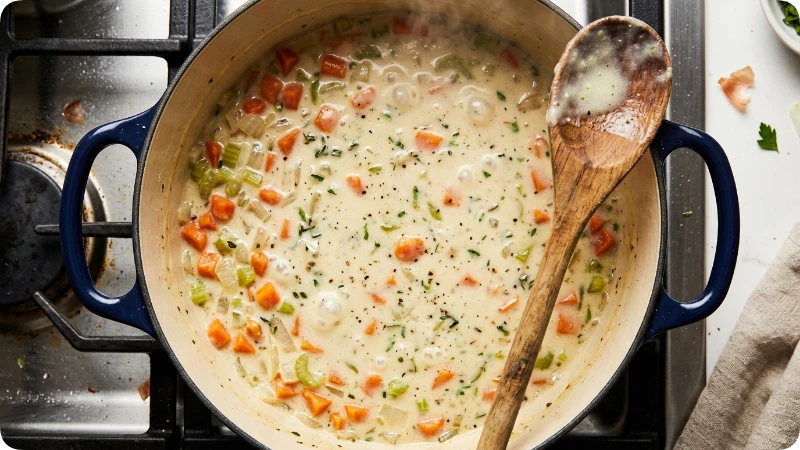
The backbone of chicken pot pie is a chicken Velvety a roux made with butter and flour, then moistened with flavorful stock and enriched with cream. Cooking the flour in melted butter for a full two minutes coats each starch granule with fat and toasts the starches slightly, eliminating any lingering paste flavor.
Pouring in the stock gradually while whisking prevents clump formation. As the liquid reaches a simmer, the starches gelatinize and swell, thickening the sauce to “nappe” consistency—meaning it coats the back of a wooden spoon or spatula without running off like broth.
[Roux + Warm Stock + Cream]
│
▼
[Simmer 3-5 min to Nappe Consistency]
│
▼
[Fold in Cooked Chicken & Frozen Peas]
Pastry Expansion Dynamics
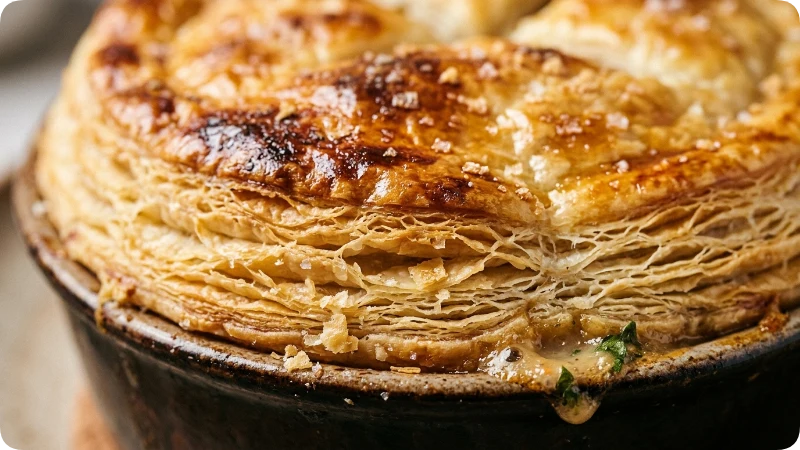
Puff pastry relies on physical leavening: alternating laminations of dough and fat. In the hot 400°F (204°C) oven, moisture trapped within the dough layers turns to steam, forcing the thin sheets of dough apart while the melting butter keeps them distinct and tender.
Cutting purposeful steam vents is critical. Without vents, the moisture evaporating from the filling becomes trapped under the crust, creating a pressurized dome that softens the underside of the dough and causes the edges to blow out or leak filling over the rim.
Tips and Troubleshooting
- Problem: The bottom of the puff pastry crust is gummy or raw.
- Cause: The filling was piping hot when the pastry was applied, melting the fat layers, or the pie was removed before bottom heat penetrated the center.
- Prevention: Cool the filling for 10 to 15 minutes before applying the pastry. Bake on the middle rack using a pre-warmed rimmed sheet pan to focus bottom conductive heat into the dish.
- Fix: If the top is already deep brown, tent the pie loosely with aluminum foil and continue baking for an additional 8 to 10 minutes until the center bubbling is vigorous.
- Problem: The puff pastry did not rise or flake.
- Cause: The pastry became too warm during rolling, or excess egg wash dripped down the cut edges, bonding the individual dough layers together.
- Prevention: Keep the pastry chilled right up until baking; glaze the top surface only, leaving the cut outer edges dry.
- Fix: Cannot be undone once baked; serve as is—the crust will still retain a buttery, short texture.
- Problem: The filling boiled over and flooded the pastry top.
- Cause: The baking dish was overfilled (less than 1/2 inch of headspace remaining) or steam vents were too small or omitted.
- Prevention: Leave at least 1/2 inch to 3/4 inch of headspace between the top of the filling and the pastry rim. Cut at least three 1-inch vents.
- Fix: Place a sheet pan underneath the pie to catch liquid, and use a clean paper towel to blot any liquid sitting directly atop the unbaked crust.
Variations and Alternative Methods
Individual Ramekins
- Divide the warm filling evenly among four to six 8-ounce oven-safe ramekins.
- Cut the rolled puff pastry into rounds roughly 1/2 inch wider than the rim of each ramekin.
- Brush the rims with egg wash, adhere the pastry rounds, cut a single slit in each, and bake at 400°F (204°C) on a baking sheet for 18 to 22 minutes until puffed and golden. Check that the internal filling registers 165°F (74°C).
Pre-Baked Pastry “Lids” (Guaranteed Crispness)
- To guarantee zero sogginess on the underside, cut the rolled pastry to the dimension of your baking dish (or into individual squares).
- Place the pastry cutouts onto a parchment-lined baking sheet, brush with egg wash, score lightly, and bake separately at 400°F (204°C) for 15 to 18 minutes until fully puffed and golden throughout.
- Meanwhile, heat the filling completely on the stovetop until simmering and registering 165°F (74°C).
- Ladle the hot filling into bowls and set the hot, crisp baked pastry square directly on top immediately before serving.
Serving Suggestions
Because this dish is hearty, starch-rich, and rich with dairy, it pairs best with bright, acidic sides that cut through the richness:
- Crisp Green Salad: Tender butter lettuce or mixed greens tossed in a sharp lemon-dijon vinaigrette.
- Steamed Green Vegetables: Simply prepared green beans, roasted asparagus, or broccolini seasoned with sea salt and lemon zest.
- Portioning: Use a large, wide serving spoon to cut through the crisp crust, scooping up a balance of pastry and filling into wide, shallow bowls.
Make-Ahead, Storage, Freezing, and Reheating
Make-Ahead
Prepare the filling up to 2 days in advance. Cool it quickly by spreading it in a shallow container, cover tightly, and store in the refrigerator at or below 40°F (4°C). When ready to bake, reheat the filling on the stovetop until warm throughout (around 120°F to 130°F / 49°C to 54°C) before pouring it into your baking dish, topping with cold pastry, and baking as directed.
Refrigerator Storage
Cool leftover baked pot pie to room temperature within 2 hours of baking. Transfer leftovers to an airtight container or cover the baking dish tightly with aluminum foil. Store in the refrigerator at or below 40°F (4°C) for up to 3 to 4 days.
Freezing
- Unbaked Pie: Not recommended with thawed commercial puff pastry. Refreezing previously thawed raw commercial puff pastry damages its laminated fat structure, leading to poor rising and flat pastry.
- Baked Pie: Bake completely and cool to room temperature. Wrap the entire dish securely in plastic wrap followed by heavy-duty aluminum foil. Freeze for up to 2 months at 0°F (-18°C). Thaw overnight in the refrigerator before reheating.
Reheating Instructions
Never microwave leftover pot pie if you want crisp pastry; microwaving steams the pastry and turns it limp and spongy.
- Preheat oven to 350°F (177°C).
- Place individual portions or the entire dish onto a baking sheet.
- Tent loosely with foil if the pastry is already well-browned.
- Bake for 15 to 20 minutes (25 to 35 minutes for a full dish) until the filling is bubbling and registers an internal temperature of at least 165°F (74°C) on an instant-read thermometer.
Nutrition Estimates
Values are calculated estimates based on standard USDA nutrient database ingredients for the base recipe yielding 6 portions. Real-world nutrition will vary based on specific poultry cuts and pastry brands.
- Serving Size: Approx. 1 1/3 cups filling with pastry topping
- Calories: 580 kcal
- Total Fat: 36 g
- Saturated Fat: 16 g
- Cholesterol: 115 mg
- Sodium: 620 mg
- Total Carbohydrates: 38 g
- Dietary Fiber: 3 g
- Total Sugars: 4 g
- Protein: 26 g
FAQs
Can I use raw chicken in this recipe?
No. Raw chicken will release excess moisture into the filling as it cooks, diluting the Velvety and resulting in a watery, separated sauce. Cook and shred or dice the chicken before incorporating it into the filling, or use pre-cooked rotisserie chicken.
Can I put puff pastry on the bottom of the pie too?
It is not recommended. The weight and moisture of the wet filling will trap the bottom pastry layer against the dish, preventing the butter from evaporating and leavening the dough. The bottom layer will remain a soggy, dense paste. For a bottom-and-top crust, standard rolled pie dough (shortcrust) is required.
How do I keep the pastry from sticking to my work surface?
Dust your work surface, rolling pin, and the top of the pastry dough lightly with all-purpose flour. Work quickly while the dough is cold. If the dough warms up and begins sticking or stretching unevenly, slide it onto a baking sheet and chill it in the refrigerator for 10 minutes before continuing.
Why did my sauce thin out after baking?
Sauces thickened with flour can thin if boiled too vigorously for too long (breaking the starch chains) or if watery vegetables (such as un-sautéed mushrooms or un-drained thawed vegetables) release moisture into the sauce. Sauté mushrooms until dry and use frozen peas straight from the freezer without thawing and sitting in water.
Can I bake this in a cast iron skillet?
Yes. An oven-safe 10-inch cast iron skillet works well as a true one-pan option. Build the filling in the skillet on the stovetop, remove from heat to cool slightly, lay the trimmed puff pastry sheet directly over the top of the skillet, cut vents, and bake as directed.
Final Summary
This chicken pot pie recipe with puff pastry provides an efficient, reliable method for creating a classic comfort food staple with a lighter, crisp top crust.
By substituting standard double-crust short crust pastry with commercial puff pastry, the recipe eliminates tedious crust crimping and blind baking while enhancing textural contrast.

Leo Campbell is the founder, recipe developer, and culinary voice behind Recipe Morsil. With nearly a decade of hands-on home cooking and professional baking experience, Leo tests every recipe multiple times to ensure reliable, fail-proof results in real home kitchens. When he’s not fine-tuning spices or testing cook times, he’s helping home cooks build confidence one bite at a time.
Connect with Leo via [Instagram/Email] or explore his verified recipes below.