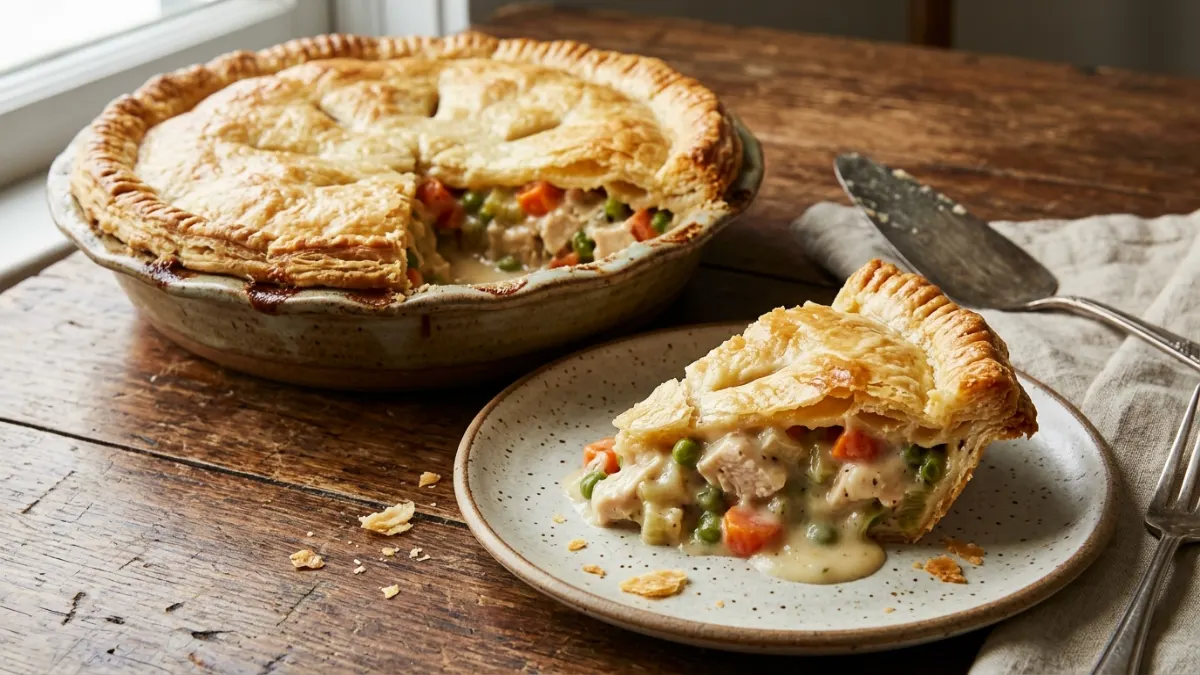
Quick Answer: Bake tender shredded chicken and vegetables simmered in a roux-thickened cream velouté beneath a vented, golden-brown pie crust or puff pastry at 400°F for 30–35 minutes.
Improved Intro Paragraph Nothing defines cozy American comfort food quite like a classic chicken pot pie, featuring tender shredded chicken, sweet carrots, peas, and celery swimming in a rich, velvety velouté sauce beneath a shatteringly crisp, golden pastry lid. The secret to perfection lies in balancing a fully baked, flaky crust with a roux-thickened cream filling that stays silky and luscious rather than turning runny or gummy. Built on everyday pantry staples and easily adapted for leftover roast chicken or store-bought rotisserie, this hearty, scratch-made skillet dinner brings nostalgic warmth and steakhouse-level satisfaction straight to your weeknight table.
A Quick Note from Our Kitchen: This recipe is formulated around classical French velouté sauce fundamentals and balanced oven-baking dynamics. To keep your bottom crust delightfully crisp and prevent sogginess, cut a few small steam vents in the top pastry and let the baked pie rest for 10 minutes before slicing so the creamy filling can settle!
Creamy Chicken Pot Pie
A classic deep-dish pot pie featuring tender cooked chicken and vegetables enrobed in a rich cream sauce under a crisp, golden crust.
- Yield: 1 deep-dish pie (approx. 6 cups filling)
- Serving Size: 1 generous slice (1/6th of pie)
- Servings: 6
- Prep Time: 20 minutes
- Cook Time: 45 minutes
- Inactive Rest Time: 15 minutes
- Total Elapsed Time: 1 hour 20 minutes
- Equipment: 9-inch deep-dish pie plate (approx. 1.5–2 quart capacity, 2 inches deep), 10-to-12-inch heavy-bottomed skillet or Dutch oven, whisk, rimmed baking sheet.
Ingredients
Filling:
- 4 tablespoons (56 g) unsalted butter
- 1 medium yellow onion, finely diced (about 1 cup / 150 g)
- 2 medium carrots, peeled and sliced into 1/4-inch rounds (about 1 cup / 120 g)
- 2 medium celery ribs, sliced into 1/4-inch crescents (about 3/4 cup / 90 g)
- 2 cloves garlic, finely minced
- 1/3 cup (42 g) all-purpose flour
- 2 cups (480 ml) low-sodium chicken broth, warm
- 1/2 cup (120 ml) heavy whipping cream (minimum 36% milkfat)
- 1 teaspoon kosher salt (Diamond Crystal; if using Morton, use 3/4 tsp)
- 1/2 teaspoon freshly cracked black pepper
- 1 teaspoon fresh thyme leaves, stripped and chopped (or 1/2 tsp dried thyme)
- 3 cups (approx. 400 g) cooked chicken breast or thigh meat, shredded or cut into 1/2-inch cubes
- 1 cup (130 g) frozen sweet peas, unthawed
Pastry & Assembly:
- 1 sheet commercial all-butter puff pastry (thawed according to package directions, approx. 14 oz / 400 g) OR 1 unbaked standard 9-inch rolled pie crust
- 1 large egg
- 1 tablespoon (15 ml) whole milk or water (for egg wash)
- 1/4 teaspoon flaky sea salt (optional, for crust topping)
Instructions
- Preheat and Prepare Equipment: Position an oven rack in the lower-middle position. Place a rimmed baking sheet on the rack and preheat the oven to 400°F (204°C). The hot baking sheet will catch spills and direct immediate bottom heat to crisp the pastry.
- Sauté the Aromatics: Melt the butter in a 12-inch skillet over medium heat. Once foaming subsides, add the diced onion, carrots, and celery. Cook, stirring occasionally, until the onions turn translucent and the carrots begin to soften, 6 to 8 minutes. Add the minced garlic and cook until fragrant, about 45 to 60 seconds, without browning.
- Build the Velouté Base: Sprinkle the 1/3 cup all-purpose flour evenly over the vegetables. Stir constantly for 1 to 2 minutes, ensuring the flour coats all vegetables and cooks out its raw starch taste (the mixture will form a thick paste on the bottom of the pan).
- Incorporate Liquids: Slowly pour in the warm chicken broth in a steady stream while whisking continuously to prevent lumps. Bring the sauce to a gentle simmer over medium heat. Simmer for 3 to 4 minutes, stirring constantly, until the liquid thickens significantly and coats the back of a spoon.
- Enrich and Season: Reduce the heat to low. Stir in the heavy cream, kosher salt, black pepper, and fresh thyme. Simmer gently for 2 minutes to meld flavors.
- Add Protein and Peas: Stir in the cooked shredded chicken and frozen peas. Remove the skillet from heat. Taste the sauce and adjust salt and pepper if desired. (The chicken should register at or above 165°F / 74°C when reheated in the hot sauce; ensure pre-cooked poultry was handled safely prior to assembly).
- Fill the Dish: Pour the warm filling directly into the 9-inch deep-dish pie plate. Smooth the top with a spatula. Let sit for 5 minutes while you roll the pastry.
- Top with Pastry: Roll out your pastry on a lightly floured surface so it extends roughly 1 inch beyond the rim of the pie plate. Lay the pastry over the filling. Trim excess overhang to about 1/2 inch, tuck the edges under along the rim of the dish, and crimp or press gently with a fork to seal.
- Vent and Glaze: Whisk the egg and milk together in a small bowl. Brush the pastry lightly and evenly with the egg wash. Cut 4 to 5 slits (each 1 to 2 inches long) in the center of the crust with a sharp paring knife to allow steam to escape. Sprinkle lightly with flaky sea salt if using.
- Bake: Set the pie dish directly onto the preheated rimmed baking sheet in the oven. Bake at 400°F (204°C) for 30 to 35 minutes. Check at the 20-minute mark; if the top crust is browning too quickly, tent loosely with a sheet of aluminum foil. Bake until the pastry is deep golden brown and the filling is visibly bubbling through the center vents.
- Rest and Serve: Transfer the pie plate to a wire cooling rack. Let rest for 15 minutes before slicing. This allows the starches in the sauce to set so the filling does not pour out when cut.
Ingredient Notes and Substitutions
- Chicken Meat: Pre-cooked rotisserie chicken, leftover roasted chicken, or poached chicken breasts work reliably. Both white and dark meat are suitable; dark meat retains extra moisture, while breast meat absorbs the sauce cleanly.
- Heavy Whipping Cream: Heavy cream (36% to 40% fat) provides body and prevents curdling when brought to a simmer. You can substitute half-and-half (equal parts milk and cream), but the resulting velouté will be noticeably thinner; reduce the chicken broth by 2 tablespoons to compensate. Avoid fat-free milk, which will break or yield a watery sauce.
- Flour: Standard all-purpose flour provides the structural thickening power. For a gluten-free filling, replace the 1/3 cup flour with 2 tablespoons of cornstarch mixed into 1/4 cup of the cold broth, stirring it into the simmering liquid at the end rather than cooking it into the butter.
- Pastry Selection: A sheet of thawed all-butter puff pastry creates a high-rising, flaky lid with minimal prep. Alternatively, a traditional rolled shortcrust pie dough delivers a sturdier, savory crust. If using a double crust (bottom and top), blind-bake the bottom shell for 10 minutes before filling to prevent a soggy base.
Before You Begin
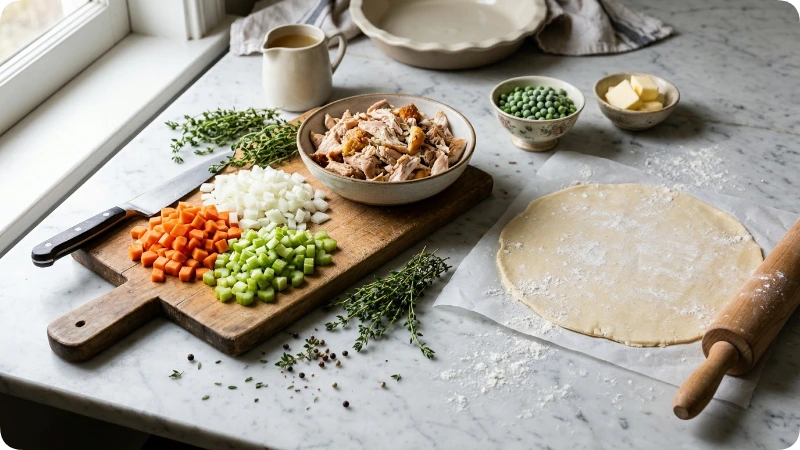
- Thaw the Pastry Safely: If using frozen puff pastry, thaw it in the refrigerator overnight (approx. 8–10 hours) or on the counter for 30 to 40 minutes until pliable but still cold to the touch. If the pastry warms past room temperature, the butter layers will melt, preventing proper puffing.
- Temperature Check: Ensure your cooked chicken is completely cool or room temperature before shredding. Never leave cooked chicken out at room temperature for more than 2 hours (or 1 hour above 90°F / 32°C).
- Preheat the Baking Sheet: Placing the pie dish on a hot baking sheet accomplishes two tasks: it catches any butter or bubbling gravy that overflows, and it conducts immediate heat upward through the base of the dish.
How to Make It: Key Decisions and Visual Cues
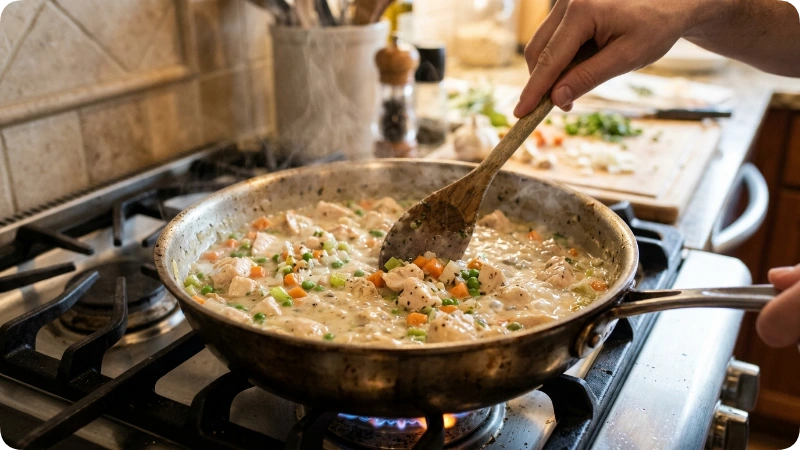
- Cooking the Roux: When flour meets the butter-sautéed vegetables, watch the bottom of the pan. A light film should form, and the raw flour smell should turn slightly nutty within 90 seconds. Do not let the flour brown heavily; a light blond roux preserves a clean, ivory-colored cream sauce.
- Whisking the Stock: Pour the stock gradually while keeping the whisk in motion. Dumping liquid all at once into a vegetable-roux mixture traps pockets of dry flour inside vegetable crevices, leading to small lumps.
- Viscosity of the Velouté: Before the chicken is added, test the sauce with the back of a spoon. Run your finger through the coated spoon; the line should hold cleanly without running together. If it is too thin, simmer for an additional 2 to 3 minutes.
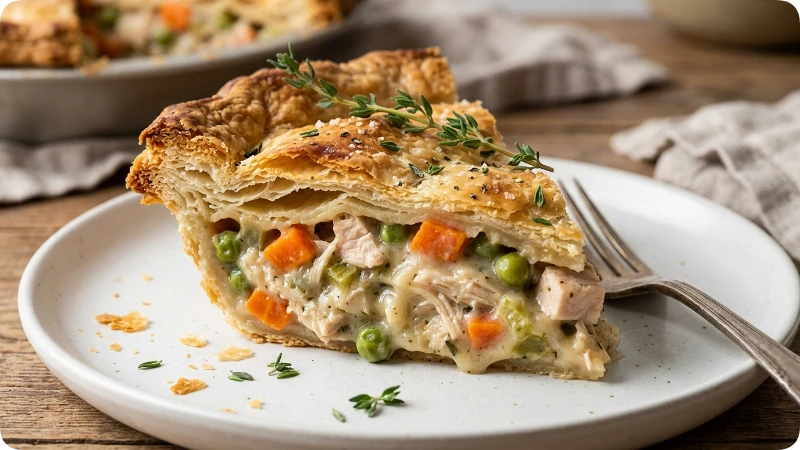
- Venting Is Non-Negotiable: Steam generated by the bubbling filling must have an exit path. Without generous vent slits, trapped steam will push up against the bottom of the dough, making the underside gummy and soggy while forcing the filling out of the side crimps.
Tips and Troubleshooting
- Problem: The bottom of the pastry crust is gummy or raw.
- Cause: Trapped moisture, an underheated oven bottom, or pouring boiling-hot filling into an unvented crust.
- Prevention: Bake on a preheated baking sheet placed on the lowest oven rack. Cut large vents. Let the filling cool slightly (5 minutes) before draping the crust.
- Fix: Cannot be fixed after baking is complete; return the pie to the lower rack, tent the top with foil, and bake 8 to 10 minutes longer.
- Problem: Filling turns watery after slicing.
- Cause: Slicing the pie immediately straight from the oven, or using watery frozen vegetables without adjusting liquid.
- Prevention: Always observe the 15-minute rest period. Starches only finish firming as the sauce drops from boiling temperature (212°F / 100°C) down to serving temperature (around 160°F / 71°C).
- Fix: Spoon the loose sauce back over the sliced portion on the plate; the flavor remains unchanged.
- Problem: Pastry burns before filling bubbles.
- Cause: Oven running hotter than indicated, or sugar/dairy glaze burning.
- Prevention: Tent a sheet of aluminum foil loosely over the crust as soon as it reaches a warm honey-brown hue (typically around minute 20).
- Fix: Remove from heat once the filling visibly bubbles through the vents.
Variations and Alternative Methods
- Individual Pot Pies (Ramekins): Divide the filling among four to six 8-ounce oven-safe ramekins. Cut rounds of pastry 1/2 inch wider than the ramekin diameter, drape, vent, and bake on a sheet pan at 400°F (204°C) for 20 to 25 minutes until golden.
- Skillet Pot Pie (Single-Pan Method): Use an oven-safe 10- or 12-inch cast-iron skillet. Prepare the entire filling directly in the skillet, remove from heat, drape the pastry directly over the skillet rim, cut vents, and transfer the entire skillet to the oven. Bake for 28 to 32 minutes.
- Mushroom and Herb Variation: Add 8 ounces (225 g) of sliced cremini mushrooms to the skillet with the aromatics and cook until browned and their liquid has evaporated before adding the flour. Add 1 tablespoon of finely chopped fresh flat-leaf parsley along with the thyme.
Serving Suggestions
Creamy chicken pot pie is an all-in-one meal containing protein, starch, and vegetables. To balance the buttery, rich velouté:
- Serve with a crisp green salad tossed in a sharp red-wine vinaigrette or lemon-dijon dressing.
- Pair with steamed green beans, roasted asparagus, or glazed baby carrots for additional color.
- Avoid heavy starch sides such as mashed potatoes or rice, which compete with the pastry crust.
Make-Ahead, Storage, and Reheating
- Make-Ahead (Unbaked): Prepare the filling completely and chill it in an airtight container for up to 24 hours. When ready to bake, transfer the cold filling to the pie plate, top with fresh pastry, cut vents, and bake. Add 10 to 12 minutes to the baking time to ensure the cold center reaches 165°F (74°C).
- Refrigerator Storage: Store cooled leftover pie covered tightly with foil or in an airtight container for up to 3 to 4 days at or below 40°F (4°C).
- Freezing (Unbaked): Assemble the pie in an aluminum freezer-safe pie pan. Do not apply egg wash. Freeze solid, wrap tightly in two layers of plastic wrap and one layer of heavy-duty aluminum foil, and store for up to 2 months. Bake directly from frozen at 375°F (190°C) for 55 to 65 minutes (tenting with foil halfway through) until the center bubbles and reads 165°F (74°C).
- Reheating: Avoid the microwave, which turns pastry soggy and rubbery. Reheat slices in a 350°F (177°C) oven or toaster oven for 12 to 15 minutes until heated through and the crust regains crispness.
FAQs
Can I use raw chicken in the filling?
No. This recipe relies on pre-cooked chicken. Raw chicken releases excess water into the sauce as it poaches, throwing off the liquid-to-flour ratio and creating a thin, soupy filling while risking undercooked meat. Always use cooked poultry.
How do I prevent the top crust from sinking into the sauce?
Fill the pie dish until the filling is nearly level with the rim. If there is a deep void between the sauce and the crust, the pastry will sag into the pan as it softens before crisping. Using a cold, taut sheet of pastry anchored firmly to the rim also prevents sinking.
Can I make this dairy-free?
Yes. Substitute unsalted vegan butter block for the dairy butter, use an equal amount of unsweetened full-fat oat milk or culinary coconut cream in place of the heavy cream, and glaze the pastry with plain water or plant milk instead of an egg-and-dairy wash.
Why is my filling too thick before baking?
If your stove heat was high, excess water may have evaporated while simmering the broth. Stir in an extra 2 to 4 tablespoons of warm chicken broth to loosen the sauce before transferring it into the pie dish. It should resemble thick country gravy.
Enjoy your homemade chicken pot pie hot from the oven after its brief rest for the cleanest, most satisfying slices.
Summary
This creamy chicken pot pie recipe combines tender shredded chicken, carrots, celery, and sweet peas inside a velvety, roux-thickened cream sauce beneath a crisp puff pastry lid. Baked at 400°F until bubbling and deeply golden, this deep-dish comfort classic delivers dependable texture, rich flavor, and straightforward assembly for family dinners.

Leo Campbell is the founder, recipe developer, and culinary voice behind Recipe Morsil. With nearly a decade of hands-on home cooking and professional baking experience, Leo tests every recipe multiple times to ensure reliable, fail-proof results in real home kitchens. When he’s not fine-tuning spices or testing cook times, he’s helping home cooks build confidence one bite at a time.
Connect with Leo via [Instagram/Email] or explore his verified recipes below.