Quick Answer: Dry-brine your prime rib overnight, slow-roast at 225°F (107°C) until medium-rare, rest for 30 minutes, and finish with a high-heat 500°F (260°C) blast for a crisp crust.
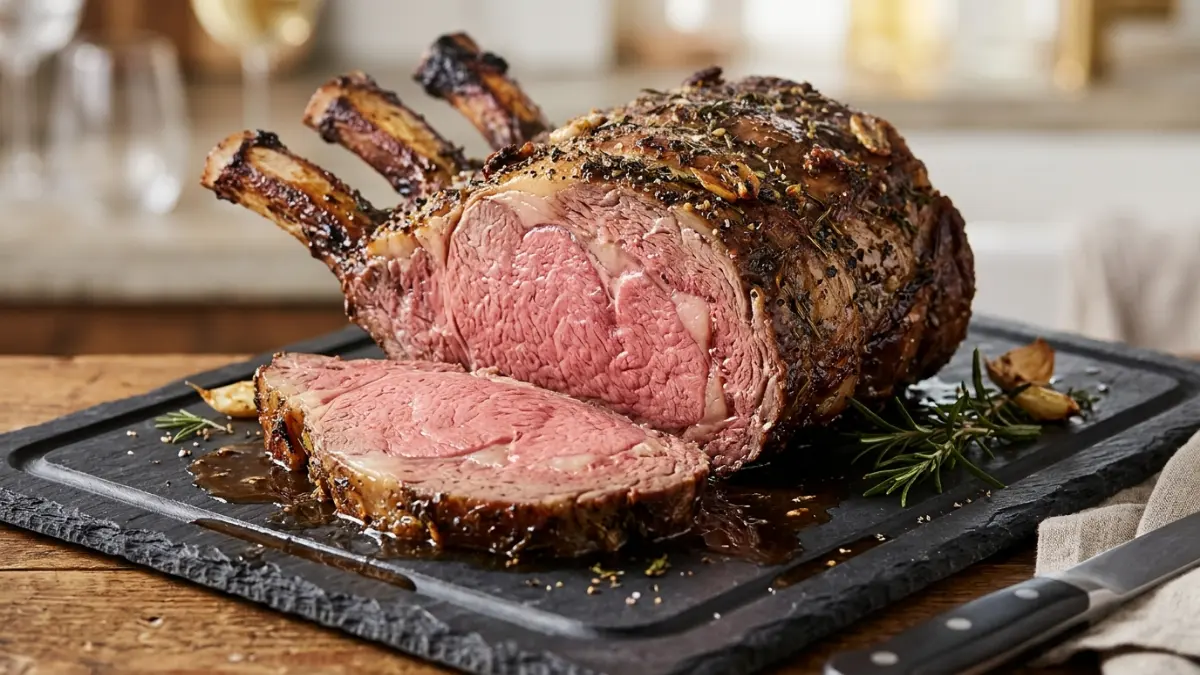
A classic standing rib roast widely loved as prime rib is the undisputed king of holiday dinners, prized for its rich beef flavor, generous marbling, and melt-in-your-mouth tenderness. Traditional high-heat roasting often ruins this prized cut by leaving thick, dry gray bands near the edges before the center ever warms up. Our foolproof reverse-sear method eliminates the guesswork: an overnight dry brine seasons the meat deeply, a gentle low-and-slow roast cooks the interior evenly to edge-to-edge pink perfection, and a final blast in a blazing 500°F oven delivers a shatteringly crisp, golden-brown crust. Whether it is Christmas dinner or a special celebration, this straightforward technique guarantees steakhouse-caliber perfection straight from your home oven.
A Quick Note from Our Kitchen: This recipe is built on proven thermal meat science and reverse-sear roasting standards. Because every oven and rib roast size varies slightly, always rely on a calibrated instant-read or leave-in probe thermometer pulling your roast at 120°F to 125°F before resting guarantees a picture-perfect medium-rare center!
Standing Prime Rib Roast Recipe
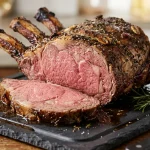
A classic bone-in standing rib roast seasoned with a salt dry-brine, coated in garlic-herb butter, roasted gently, and seared crisp.
- Yield: 6 to 8 servings
- Portion Size: Approx. 8–10 oz carved beef per serving
- Prep Time: 20 minutes
- Active Cook Time: 3 hours 15 minutes to 3 hours 45 minutes
- Inactive Time: 12 to 24 hours (chilled dry brine) + 30 minutes (post-roast rest)
- Total Elapsed Time: 16 hours 5 minutes to 28 hours 35 minutes
- Essential Equipment: Heavy roasting pan with a sturdy flat or V-shaped wire rack, butcher’s twine, probe thermometer or instant-read digital meat thermometer, chef’s knife or carving knife, cutting board with a juice groove.
Ingredients
The Roast & Dry Brine
- 1 bone-in prime rib roast (3 bones, approx. 6 to 7 lbs / 2.7 to 3.2 kg), chine bone removed, fat cap trimmed to 1/4 inch
- 2 tablespoons (36g) coarse kosher salt (e.g., Diamond Crystal; if using Morton, use 1 1/4 tablespoons / 23g)
Garlic-Herb Butter Crust
- 1/2 cup (1 stick / 113g) unsalted butter, softened to room temperature
- 6 cloves garlic, minced to a paste (approx. 2 tablespoons)
- 1 tablespoon finely chopped fresh rosemary leaves
- 1 tablespoon finely chopped fresh thyme leaves
- 2 teaspoons freshly cracked coarse black pepper
Pan Au Jus
- 1 medium yellow onion, roughly chopped
- 1 large carrot, roughly chopped
- 1 rib celery, roughly chopped
- 1 1/2 cups (360ml) low-sodium beef bone broth or rich beef stock
- 1/2 cup (120ml) dry red wine (Cabernet Sauvignon or Pinot Noir; optional—substitute with additional stock)
Instructions
Dry-Brine and Prep the Roast
- Dry-brine the roast (12 to 24 hours in advance): Pat the roast dry on all surfaces using paper towels. If the bones were cut away and retied by your butcher, verify the twine is secure. Rub the coarse kosher salt evenly over all sides, including the cut faces and the fat cap. Place the meat fat-side up on a wire rack set inside a rimmed baking sheet. Transfer uncovered to the bottom shelf of your refrigerator for 12 to 24 hours to dry the surface and allow the salt to dissolve and penetrate inward.
- Preheat and assemble: Position an oven rack in the lower third of the oven and preheat to 225°F (107°C). Remove the roast from the refrigerator. In a small bowl, combine softened butter, minced garlic, chopped rosemary, thyme, and black pepper, then rub this mixture evenly over the top and sides of the roast. Scatter the chopped onion, carrot, and celery into the base of a heavy roasting pan, set the roasting rack directly over the vegetables, and place the roast on the rack bone-side down (fat-side up).
Low-Temperature Roasting
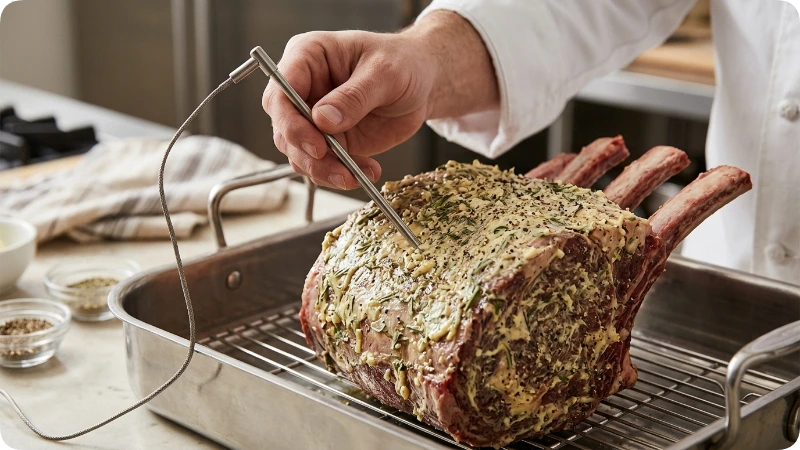
- Slow roast: Insert an oven-safe leave-in probe thermometer into the deepest center of the meat, ensuring the tip does not touch bone or heavy fat pockets. Transfer to the oven and roast at 225°F (107°C) until the internal temperature reaches 118°F to 120°F (48°C to 49°C) for rare, or 125°F to 128°F (52°C to 53°C) for medium-rare. A 6-to-7-pound 3-bone roast typically takes between 2 hours 45 minutes and 3 hours 30 minutes at this temperature.
Rest and Make the Au Jus
- Remove and rest: Transfer the roast on its rack to a rimmed sheet pan or cutting board. Tent the roast loosely with a large sheet of aluminum foil (do not wrap tightly, or the surface will steam). Allow the roast to rest at room temperature for 30 to 45 minutes; the internal temperature will rise 3°F to 5°F via gentle carryover heat.
- Prepare the au jus: While the meat rests, place the roasting pan with the aromatic vegetables over medium heat on your stovetop (spanning two burners if needed). Pour in the red wine to deglaze, scraping up any browned pan drippings with a wooden spoon for 2 minutes. Pour in the beef stock and simmer gently until the liquid reduces by roughly one-third (about 6 to 8 minutes). Strain through a fine-mesh sieve into a gravy boat, pressing lightly on the solids, and discard the solids. Skim excess fat off the top surface, season with a pinch of salt and pepper to taste, and keep warm.
High-Heat Sear and Carve
- High-heat sear: Fifteen minutes before serving, crank the oven to 500°F (260°C) or set to its highest bake setting. Remove the foil tent from the rested roast and return the roast (still on its rack) to the oven. Roast for 8 to 12 minutes, watching closely through the door, until the outer crust is deeply browned, sizzling, and crackling.
- Carve and serve: Transfer the roast immediately to a carving board. Snip and remove the butcher’s twine, then slice downward along the curve of the ribs to detach the bones in one piece (reserve ribs for snacking or broth). Carve the boneless roast crosswise into 1/2-inch to 3/4-inch slices and serve immediately with the hot pan au jus.
Ingredient Notes and Substitutions
- Beef Cut: Look for USDA Choice or Prime grade, labeled as “bone-in ribeye roast” or “standing rib roast.” A 3-bone cut typically feeds 6 to 8 people generously. If using boneless prime rib, reduce roasting time by roughly 20 to 30 minutes; insert the probe into the dead geometric center.
- Salt Type: Coarse kosher salt dissolves slowly and coats evenly without over-salting. If using standard fine table salt, reduce the measured volume by half (1 tablespoon / 18g) to prevent an excessively salty exterior.
- Fats and Herbs: Softened butter forms a base that helps herbs stick to the dry fat cap while providing milk solids that brown under the high-heat blast. If you prefer high-smoke point alternatives, substitute softened butter with 3 tablespoons of neutral high-heat oil (such as avocado oil) or beef tallow.
Before You Begin: Strategic Kitchen Prep
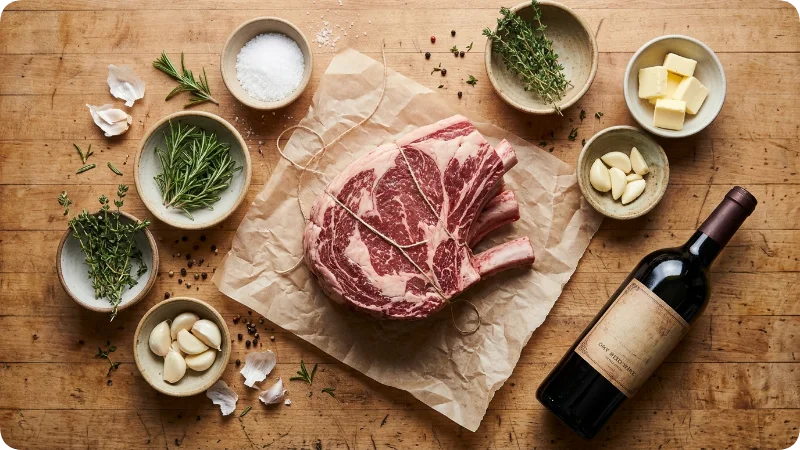
- Clear Refrigerator Space: Dry-brining requires an open baking sheet on an uncrowded refrigerator shelf for up to 24 hours. Ensure raw beef sits below ready-to-eat items to prevent cross-contamination.
- Thermometer Calibration: Do not rely on time-per-pound metrics alone. Check your digital thermometer probe beforehand in ice water ( 32°F ) to guarantee accurate readings.
How to Make It: Thermal Principles and Visual Cues
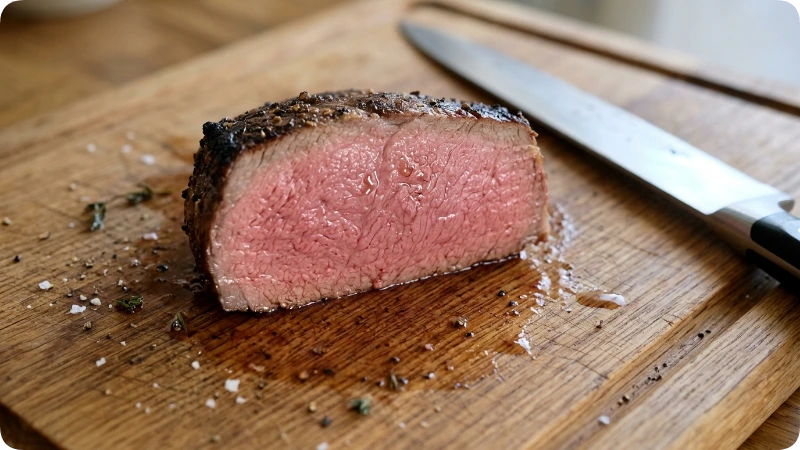
The Reverse Sear Advantage
Traditional roasting methods start hot and finish low, creating a bullseye pattern: gray, overdone outer meat with a tiny circle of pink in the center. The reverse-sear flips this sequence. Gentle 225°F ( 107°F) dry heat dehydrates the outer crust while gently warming the interior, keeping enzymes active longer to naturally tenderize the muscle fibers.
The cooking process follows four sequential stages: dry-brining to dehydrate the exterior surface, roasting over low heat at 225°F for an even cook, resting the meat to stabilize juices, and finishing with a high-heat blast at 500°F to create a crisp Maillard-browned crust.
Carryover Heat and Temperature Targets
Because low-temperature roasting creates minimal thermal gradient (the exterior isn’t significantly hotter than the interior), carryover cooking is modest: internal temperatures typically rise only 3°F to 5°F during the rest, compared to a 10°F to 15°F spike observed in high-heat methods.
- Rare: Pull at 118°F–120°F (48°C–49°C), rests to 123°F–125°F (51°C–52°C).
- Medium-Rare: Pull at 125°F–128°F (52°C–53°C), rests to 130°F–133°F (54°C–56°C).
- Medium: Pull at 132°F–135°F (56°C–57°C), rests to 137°F–140°F (58°C–60°C).
(Note: The USDA officially recommends cooking whole beef cuts to an internal temperature of 145°F ( 63°F) with a 3-minute rest for baseline food safety. Cooking below this threshold reflects standard culinary preference for medium-rare texture.)
Tips and Troubleshooting
- Problem: The exterior isn’t browning during the 500°F flash.
- Cause: Moisture on the surface of the meat absorbed thermal energy via evaporation instead of browning.
- Prevention: Dry-brining uncovered in the refrigerator is essential; avoid basting the roast with water-based liquids during the cook.
- Fix: Move the roast to the upper rack and engage the oven broiler for 2 to 3 minutes, rotating once, keeping a constant eye on it to avoid scorching.
- Problem: Roast finishes earlier than dinner service.
- Cause: Oven runs hot or roast was narrower than expected.
- Prevention: Monitor probe readouts starting 2 hours in.
- Fix: If done early, tent loosely with foil and hold at room temperature. The dense thermal mass of a large roast will remain warm for up to an hour. Perform the 500°F sear immediately before carving.
- Problem: Uneven internal doneness.
- Cause: Probe was inserted into fat or directly against the bone, producing a false high or low temperature reading.
- Prevention: Insert probe horizontally from the side directly into the core muscle center.
Variations and Alternatives
- Boneless Rib Roast: Use the exact same dry-brine and butter rub. Set the roast directly on the rack fat-side up. Cooking time is roughly 15% to 20% faster per pound; begin monitoring internal temperature at the 2-hour mark.
- Smoker Adaptation: Follow the dry-brine step. Smoke over indirect oak or pecan wood heat at 225°F until the target internal temperature is reached. Remove, rest, and sear over direct hot coals for 2 minutes per side instead of the oven blast.
Make-Ahead, Storage, and Reheating
- Dry-Brining in Advance: The salted roast can remain uncovered in the refrigerator for up to 36 hours. Beyond 48 hours, the exterior can become leathery.
- Storing Leftovers: Cool leftover sliced or unsliced beef to room temperature within 2 hours. Wrap tightly in plastic wrap and store in an airtight container in the refrigerator for up to 4 days.
- Reheating Without Overcooking: Never reheat prime rib slices in a microwave. Place slices on a rimmed baking sheet, splash with 2 tablespoons of beef broth, cover tightly with aluminum foil, and warm in an oven preheated to 250°F ( 121°F) for 12 to 15 minutes until just warm ( 115°F to 120°F).
FAQs
Bone-in versus boneless: which is better?
Bone-in roasts insulate the meat closest to the rib, slowing heat transfer and leaving those sections exceptionally juicy. Bones also double as a natural roasting rack and yield rich flavor for homemade beef stock.
Should I bring the meat to room temperature before roasting?
Taking a cold 7-pound roast out of the fridge for 1 to 2 hours changes its internal temperature by only a few degrees, while leaving the exterior surface in the food temperature danger zone ( 40°F to 140°F). The reverse-sear method eliminates the need to temper meat beforehand.
Can I sear the roast first instead of at the end?
Searing first creates a warm, wet exterior during the long low roast, causing the crust to soften and turning the outer bands gray. Searing at the end crisps the exterior right before it hits the cutting board.
Why rest the meat before the high-heat blast?
Resting before the final sear allows the muscle fibers to relax and reabsorb juices while the internal temperature stabilizes. Searing after the rest requires only 8 to 10 minutes of heat, which re-crisps the surface without cooking the interior further, allowing immediate carving.
Summary
This classic prime rib roast pairs an overnight salt dry-brine with a low-temperature 225°F roast to achieve consistent, edge-to-edge medium-rare doneness. A 30-minute rest followed by a brief 500°F oven blast produces a crisp herb-garlic crust without overcooking the center. Carve into thick slices and serve alongside fresh pan au jus.

Leo Campbell is the founder, recipe developer, and culinary voice behind Recipe Morsil. With nearly a decade of hands-on home cooking and professional baking experience, Leo tests every recipe multiple times to ensure reliable, fail-proof results in real home kitchens. When he’s not fine-tuning spices or testing cook times, he’s helping home cooks build confidence one bite at a time.
Connect with Leo via [Instagram/Email] or explore his verified recipes below.