Quick Answer: Mix well-drained canned salmon with crushed saltine crackers, beaten eggs, onion, and lemon juice, then pan-fry in hot oil for 3 to 4 minutes per side until crisp and golden brown.
Old fashioned salmon patties often called classic Southern salmon croquettes are a timeless pantry staple loved for their crunchy, golden-brown crust and tender, savory center. Made with humble canned pink or red salmon, crushed saltine crackers, minced onion, and fresh lemon, this nostalgic skillet meal turns simple everyday staples into a deeply satisfying dinner in just 20 minutes. By focusing on smart moisture control and the right binder ratio, these patties hold together beautifully in the hot oil without falling apart or absorbing excess grease. Serve them hot with tangy tartar sauce, homemade remoulade, or classic buttermilk biscuits for an effortless, budget-friendly weeknight favorite.
A Quick Note from Our Kitchen: This recipe is modeled after traditional regional skillet-frying standards and standard seafood binder ratios. For patties that hold their shape perfectly and never crumble, drain your canned salmon thoroughly and let the shaped patties rest in the refrigerator for 10 minutes before frying!
Traditional Skillet Salmon Patties
Crisp on the outside and moist on the inside, these pantry-friendly salmon cakes deliver comforting, savory flavor with everyday ingredients.
- Yield: 6 patties (3 to 4 servings)
- Prep Time: 15 minutes
- Cook Time: 8 minutes (in batches)
- Resting/Chilling Time: 10 minutes (optional chilling for shape retention)
- Total Elapsed Time: 25 to 35 minutes
- Essential Equipment: 10- or 12-inch cast-iron skillet (or heavy stainless steel skillet), fine-mesh strainer, wide flexible metal spatula, mixing bowl.
Ingredients
For the Patties:
- 1 can (14.75 oz / 418 g) traditional canned pink or red salmon, thoroughly drained (liquid reserved separately)
- 14 standard saltine crackers (approx. ½ cup / 45 g finely crushed crumbs)
- 2 large eggs, lightly beaten
- ¼ cup finely minced yellow onion (about ½ small onion)
- 2 tbsp finely chopped fresh flat-leaf parsley (or 1 tsp dried parsley flakes)
- 1 tbsp freshly squeezed lemon juice
- ½ tsp garlic powder
- ¼ tsp freshly ground black pepper
- ¼ tsp kosher salt (reduce to ⅛ tsp if using salted crackers and salted fish)
For Frying:
- 3 to 4 tbsp neutral cooking oil with a high smoke point (canola, vegetable, or peanut oil; enough to coat the bottom of the skillet with a ⅛-inch layer)
Instructions
Prep & Flake the Salmon
- Drain and Pick Through Salmon: Open the can of salmon and press the lid firmly over a bowl to extract the canning liquid; set the reserved liquid aside. Transfer the drained salmon to a medium mixing bowl. Inspect the salmon: traditional canned salmon includes round vertebrae and soft dark skin. Both are pressure-cooked during canning and completely edible, soft enough to mash smoothly with a fork for extra calcium. If you prefer a uniform texture and lighter color, remove and discard the skin and large bone segments.
- Flake the Fish: Break the salmon apart with a fork into small, flaky pieces. Avoid over-mashing into a paste so the patties retain a desirable flaky texture.
Mix & Form the Patties
- Combine the Mixture: Add the crushed saltines, beaten eggs, minced onion, parsley, lemon juice, garlic powder, black pepper, and salt to the bowl with the flaked salmon.
- Mix and Check Consistency: Stir gently with a fork until the ingredients are evenly distributed. Let the mixture sit undisturbed for 5 minutes so the cracker crumbs absorb the moisture from the eggs and fish. Test the texture by pressing a small amount in your hand: it should pack firmly like wet sand without crumbling apart. If it feels dry and powdery, mix in 1 to 2 tablespoons of the reserved canning liquid. If it feels too wet or loose to hold shape, stir in 2 to 3 additional crushed saltines.
- Form the Patties: Divide the mixture into 6 equal portions (about ⅓ cup each). Shape each portion into a firm ball, then gently press into a compact patty about ¾-inch thick and 3 inches wide. Smooth the edges with your fingers to prevent ragged borders from breaking apart during frying. (Optional checkpoint: Place formed patties on a plate and chill in the refrigerator for 10 minutes to firm up the binder.)
Heat the Skillet & Pan-Fry
- Heat the Skillet: Set a 10- or 12-inch cast-iron skillet over medium heat. Add 3 to 4 tablespoons of oil to form a consistent ⅛-inch layer across the bottom. Heat until shimmering (roughly 350°F / 177°C if using a thermometer, or until a stray cracker crumb sizzles immediately upon contact).
- Pan-Fry (Batch 1): Gently place 3 patties into the skillet, leaving ample space between them so the pan temperature does not drop. Fry undisturbed over medium heat for 3 to 4 minutes. Do not move or press down on the patties while they cook; allow a sturdy, golden-brown crust to develop underneath.
- Flip Carefully: Slide a thin, wide spatula completely beneath each patty in one smooth motion. Flip gently and fry the second side for another 3 to 4 minutes until deep golden brown and heated through to an internal temperature of at least 160°F (71°C) to ensure the egg binder is fully set.
Drain & Serve
- Drain and Repeat: Transfer the cooked patties to a plate lined with paper towels or a wire rack set over a baking sheet to keep the bottoms crisp. Add a splash of oil to the skillet if needed, bring back to temperature, and fry the remaining 3 patties.
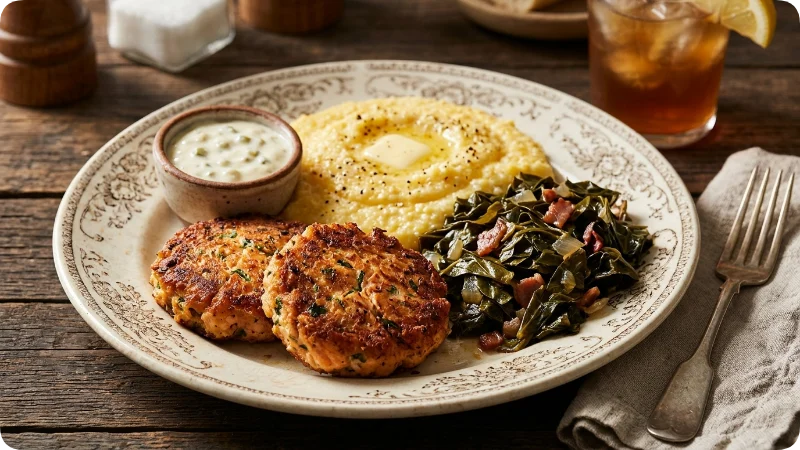
- Serve: Serve hot with fresh lemon wedges or homemade tartar sauce.
Ingredient Notes and Substitutions
- Canned Salmon Options: Traditional 14.75-ounce tall cans of wild Alaskan pink or red (sockeye) salmon are standard. Red salmon provides a firmer texture and bolder flavor; pink salmon is milder and slightly softer. If using 5- to 6-ounce smaller cans (which usually contain skinless, boneless fillets), use two to three cans to reach roughly 12 to 14 ounces of drained meat, and reduce added salt slightly as smaller cans are often more heavily pre-salted.
- Crackers vs. Breadcrumbs: Saltine crackers are the historical standard in Southern and rural American kitchens, lending a light, tender crumb without becoming heavy or dense. If saltines are unavailable, substitute an equal volume (½ cup) of plain panko breadcrumbs for extra crunch, crushed Ritz crackers for a richer buttery note, or plain dried breadcrumbs.
- Egg Binder: Two large eggs provide the necessary protein matrix to hold the flaked fish together upon coagulating in the pan. Do not reduce to one egg unless scaling down the salmon, or the patties will be prone to crumbling when flipped.
- Onion Preparation: Mince the yellow onion as finely as possible. Large chunks of raw onion create structural fault lines that cause patties to split in the skillet, and large pieces will not cook through during the brief 8-minute frying time.
Before You Begin
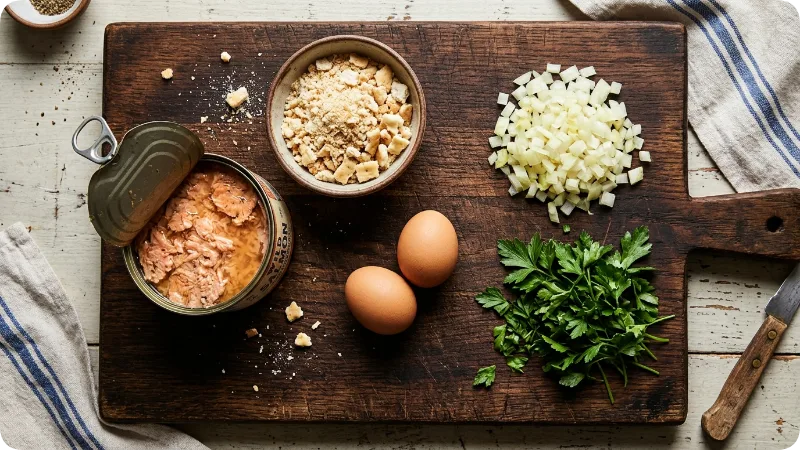
- Thorough Draining: Liquid is the primary enemy of patty cohesion. Squeeze out excess liquid from the can, but save it in a small dish in case your cracker crumbs absorb too much and the blend needs rehydrating.
- Skillet Preheating: Cast iron holds heat evenly, which produces the signature deep-gold crust. Allow your skillet 4 to 5 minutes to preheat over medium heat before adding the oil.
How to Make It: Key Decisions and Checkpoints
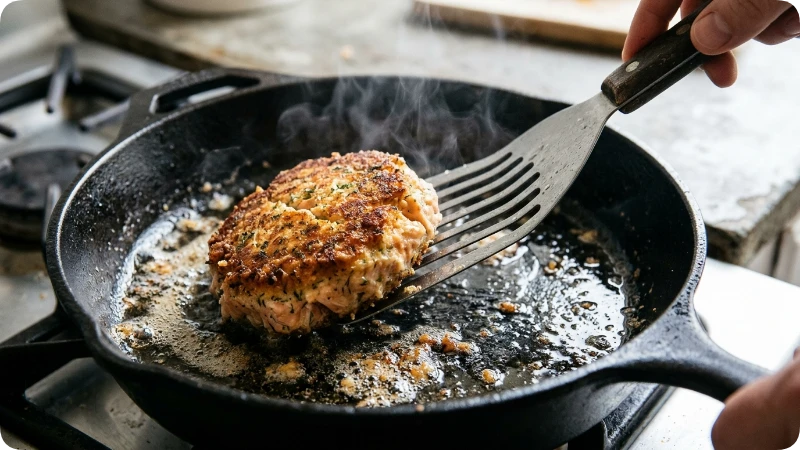
- The Rest Period: Allowing the mixed mixture to rest for 5 minutes before shaping gives the dry starch in the crackers time to hydrate. This resting step prevents greasy patties and ensures the mixture binds cleanly.
- Managing Pan Crowding: Cook in two batches of three rather than cramming all six patties into one pan. Crowding traps steam, softening the crust and cooling down the oil, which causes the patties to absorb excess grease.
- The “Leave It Alone” Rule: When the patties hit the hot oil, leave them untouched. Shifting them early interrupts crust formation and risks breaking the fragile egg-and-cracker matrix before it sets.
Tips and Troubleshooting
- Problem: Patties fall apart or crumble during the flip.
- Cause: Either the mixture was too dry, the onions were cut too coarsely, or the first side was flipped before the bottom crust set.
- Prevention: Mince onions fine; allow the formed patties to chill in the refrigerator for 10 minutes before cooking; slide a wide spatula fully underneath before flipping.
- Fix: If the mixture feels loose while shaping, beat in an extra egg white or add 2 tablespoons of cracker crumbs. If a patty breaks in the pan, gently press it back together and let the crust finish setting; it will remain delicious even if irregularly shaped.
- Problem: The exterior browns too fast while the inside stays cool.
- Cause: The skillet oil is too hot (above 375°F / 190°C).
- Prevention: Maintain medium heat. If the oil begins smoking or the first side darkens in under 2 minutes, turn the burner down to medium-low immediately.
- Problem: The patties turn out soggy or oily.
- Cause: The oil was not hot enough when the patties entered the pan, or the pan was overcrowded, dropping the temperature.
- Prevention: Ensure the oil is shimmering before adding food. Drain finished patties on a raised wire cooling rack rather than flat paper towels if holding them for several minutes.
Variations and Alternative Methods
- Baked Salmon Patties: Preheat oven to 400°F (204°C). Place formed patties on a parchment-lined or lightly greased baking sheet. Lightly brush or spray the tops with vegetable oil. Bake for 18 to 20 minutes, flipping once at the 10-minute mark, until golden brown and the internal temperature reaches 160°F (71°C). The crust will be slightly less crisp than pan-fried, but uses less oil.
- Air Fryer Method: Preheat the air fryer to 375°F (190°C). Generously spray the air fryer basket and both sides of the patties with cooking spray. Place patties in a single layer without overlapping. Air fry for 10 to 12 minutes, flipping gently at the 6-minute mark, until crisp and golden.
- Bell Pepper & Herb Add-In: For a coastal Maryland or Louisiana flair, fold in 2 tablespoons of finely minced red bell pepper, 1 teaspoon of Old Bay seasoning (omit the extra salt), and 1 teaspoon of Dijon mustard.
Serving Suggestions
- Classic Southern Plate: Serve alongside warm buttermilk biscuits, creamy grits, and braised collard greens.
- Weeknight Dinner: Pair with creamy mashed potatoes or macaroni and cheese, alongside steamed sweet corn or green beans.
- Condiments: Complement with homemade tartar sauce, remoulade, cocktail sauce, or a simple squeeze of fresh lemon juice and a dash of hot sauce.
- Sandwich Style: Serve tucked inside a toasted potato bun with crisp iceberg lettuce, sliced tomato, and mayonnaise.
Make-Ahead, Storage, and Reheating
- Make-Ahead (Uncooked): Form the patties, arrange them on a parchment-lined plate or tray, cover tightly with plastic wrap, and refrigerate for up to 24 hours before frying. Frying chilled patties helps them retain their shape exceptionally well.
- Refrigeration (Cooked): Let leftovers cool to room temperature within 2 hours of cooking. Store in an airtight container lined with a paper towel for up to 3 days.
- Freezing: Arrange cooked, cooled patties in a single layer on a baking sheet and freeze until solid (about 2 hours). Transfer to a freezer-safe zip-top bag with parchment paper between each patty. Freeze for up to 2 months. Thaw overnight in the refrigerator before reheating.
- Reheating: To restore crispness, reheat patties in a dry skillet over medium heat for 3 to 4 minutes per side, or bake in a 350°F (177°C) oven or toaster oven for 8 to 10 minutes until heated through. Avoid the microwave, which turns the crust soft and rubbery.
FAQs
Do I have to take the bones out of canned salmon?
No. The small, round spinal bones and tiny pin bones in canned salmon are thoroughly pressure-cooked during the commercial canning process. They are soft enough to easily crush between your thumb and finger or mash directly into the fish with a fork, providing an excellent source of dietary calcium without posing a choking hazard. However, you can pick them out if you prefer a smoother texture.
Can I use fresh salmon instead of canned?
Yes. Use approximately 12 to 14 ounces of cooked, cooled, and finely flaked fresh salmon fillets. Because fresh cooked salmon typically contains less moisture than canned, you may need to add 1 tablespoon of mayonnaise or milk to help the cracker crumbs hydrate and bind.
Why are my salmon patties dry?
Dry patties usually result from overcooking, discarding all moisture without testing the consistency, or using too many cracker crumbs relative to the egg and fish. Ensure you only fry until golden brown (about 3 to 4 minutes per side).
Can I make these gluten-free?
Yes. Substitute the saltine crackers with an equal volume (½ cup) of crushed certified gluten-free saltines, gluten-free round snack crackers, or gluten-free panko breadcrumbs. Check that all seasonings and canned fish are verified gluten-free.
Summary
This complete guide details how to make authentic old fashioned salmon patties using canned pink or red salmon, crushed saltine crackers, eggs, and aromatics. By properly flaking the fish, balancing moisture, and shallow-frying in a preheated cast-iron skillet, you achieve perfectly golden, crisp patties that hold together without falling apart.

Leo Campbell is the founder, recipe developer, and culinary voice behind Recipe Morsil. With nearly a decade of hands-on home cooking and professional baking experience, Leo tests every recipe multiple times to ensure reliable, fail-proof results in real home kitchens. When he’s not fine-tuning spices or testing cook times, he’s helping home cooks build confidence one bite at a time.
Connect with Leo via [Instagram/Email] or explore his verified recipes below.