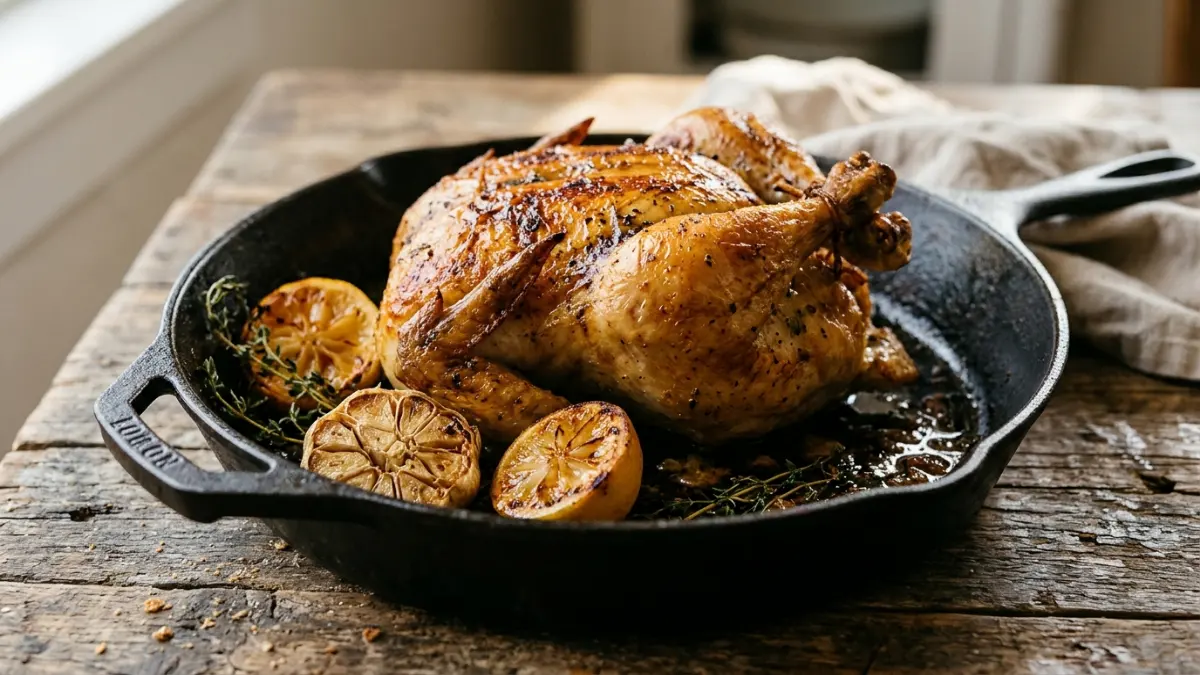
Quick Answer: Pat a 4-pound whole chicken dry, rub with seasoned butter, stuff with lemon, garlic, and herbs, then roast at 425°F until the thigh registers 165°F.
A classic roast chicken is the pinnacle of effortless home cooking: blistered, crackling-golden skin, mouthwateringly juicy meat, and deeply flavorful pan drippings. Built with simple aromatics like fresh lemon, crushed garlic, and fragrant thyme tucked inside the cavity, this high-heat method relies on pure culinary technique rather than fancy equipment. By patting the skin thoroughly dry and roasting in a hot oven, excess fat renders away cleanly to create a crisp, savory crust while locking in every drop of moisture. Whether you are serving Sunday family dinner or prepping versatile shredded protein for the week, it delivers foolproof, steakhouse-level satisfaction with under fifteen minutes of hands-on effort.
A Quick Note from Our Kitchen: This recipe is modeled after classic high-heat dry-roasting physics and USDA poultry safety standards. For the crispiest skin and juiciest bites, let your carved chicken rest on a warm cutting board for 10 to 15 minutes before carving so the savory juices redistribute throughout the meat!
Classic Herb & Garlic Simple Roast Chicken
A dependable whole-roasted chicken featuring crisp skin, aromatic pan juices, and seasoned meat.
- Yield: 4 servings (approximately 6 ounces cooked meat per serving)
- Prep Time: 20 minutes
- Active Cook Time: 50 to 60 minutes
- Inactive Resting & Chilling Time: 45 minutes (30 minutes optional skin air-dry, 15 minutes resting)
- Total Elapsed Time: 1 hour 55 minutes (or 1 hour 25 minutes if skipping the air-dry stage)
- Essential Equipment: 12-inch heavy cast-iron skillet or shallow roasting pan with a low rack; kitchen twine; digital instant-read meat thermometer
Ingredients
Poultry & Cavity Aromatics
- 1 whole whole chicken (3 1/2 to 4 pounds / 1.6 to 1.8 kg), giblets and neck removed from cavity
- 1 1/2 teaspoons kosher salt (or 1 teaspoon fine sea salt), divided
- 1/2 teaspoon freshly cracked black pepper, divided
- 1 small lemon, halved
- 1 medium head garlic, halved crosswise to expose cloves
- 4 fresh thyme sprigs
- 2 fresh rosemary sprigs
Herb Butter Rub
- 3 tablespoons unsalted butter, softened to room temperature (or extra-virgin olive oil)
- 1 clove garlic, finely minced
- 1 teaspoon fresh thyme leaves, finely chopped
Instructions
Prep and Seasoning
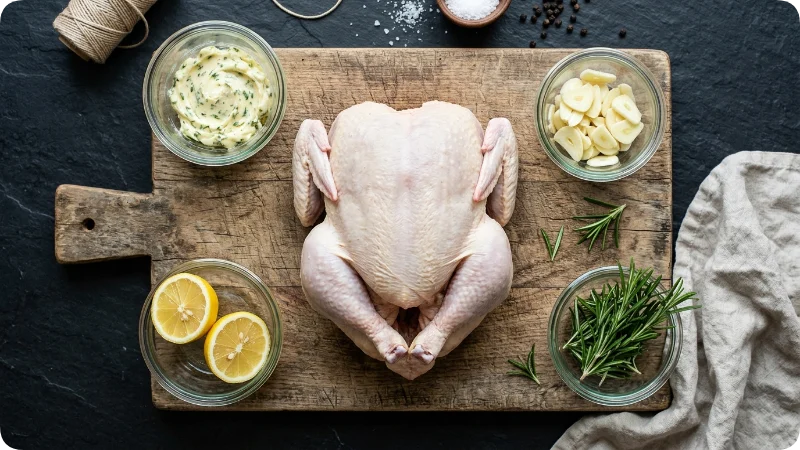
- Dry the Chicken: Remove the chicken from its packaging. Do not rinse the poultry under running water. Use clean paper towels to thoroughly pat the exterior skin and inner cavity dry.
- Loosen Skin and Season: Mix softened butter, minced garlic, chopped thyme, 1/2 teaspoon of salt, and 1/4 teaspoon of black pepper in a small bowl. Gently slide your fingers between the chicken breast skin and meat to separate the membrane. Spread approximately half of the herb butter directly under the skin over both breasts.
- Stuff the Cavity: Season the inner cavity with 1/2 teaspoon of salt and a pinch of black pepper. Insert the lemon halves, garlic head halves, thyme sprigs, and rosemary sprigs into the cavity.
- Truss and Coat: Tuck the wing tips back and underneath the bird’s shoulders to prevent burning. Tie the legs together snugly with kitchen twine across the front of the cavity opening. Rub the remaining herb butter over the outside of the chicken, coating the breast, thighs, and drumsticks evenly. Season the entire exterior with the remaining 1/2 teaspoon of salt and 1/4 teaspoon of pepper.
Roasting and Temperature Checks
- Preheat Oven: Position an oven rack in the middle position and preheat the oven to 425°F (218°C / gas mark 7). Place the prepared chicken breast-side up in a 12-inch cast-iron skillet or shallow roasting pan.
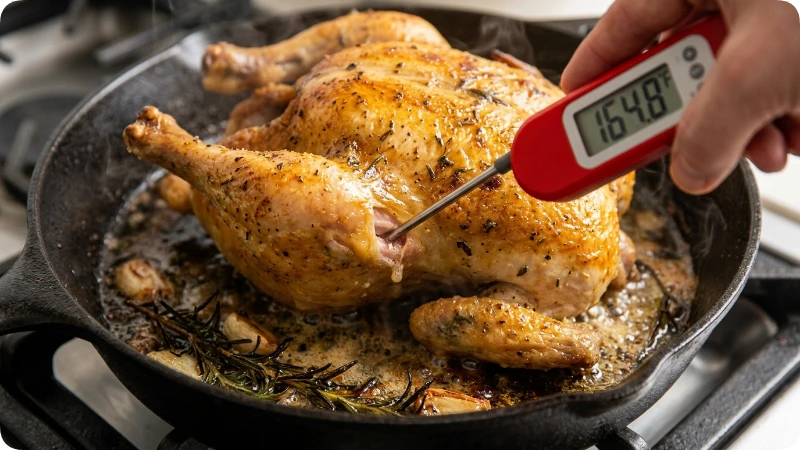
- Roast to Temperature: Transfer the pan to the preheated oven. Roast undisturbed for 50 to 60 minutes. Begin checking the temperature around the 45-minute mark. Insert an instant-read digital thermometer into the thickest part of the inner thigh, avoiding the bone. The chicken is safe and fully cooked when the internal temperature registers a minimum of 165°F (74°C). The breast meat should simultaneously register between 160°F and 165°F.
- Rest Before Carving: Carefully transfer the roasted chicken from the pan to a cutting board, tilting it slightly over the pan so juices collected in the cavity run into the skillet. Let the chicken rest uncovered for 15 minutes before carving. This rest allows the internal juices to redistribute throughout the muscle fibers.
Ingredient Notes and Substitutions
- Whole Chicken: A 3 1/2 to 4-pound “broiler-fryer” offers the best meat-to-fat ratio for even roasting. Larger chickens (5 pounds or more, often labeled “roasters”) require longer cook times and run the risk of overcooking the breast meat before the dark meat reaches safe temperatures.
- Unsalted Butter vs. Olive Oil: Softened butter browns easily and yields rich skin due to its milk solids. Extra-virgin olive oil or avocado oil is a direct 1:1 substitute that produces crisp skin without dairy.
- Salt Selection: Diamond Crystal kosher salt is the baseline. If using Morton kosher salt, reduce to 1 1/4 teaspoons; if using fine table salt, reduce to 1 teaspoon total to avoid over-salting.
Before You Begin: Handling and Air-Drying
- Raw Poultry Safety: The USDA strongly advises against washing raw chicken. Washing splatters bacteria like Campylobacter and Salmonella onto surrounding countertops and equipment. Cooking to 165°F (74°C) kills bacteria safely.
- The Air-Dry Step (Recommended): For the crispiest skin, unwrap the chicken, pat it dry, place it on a plate or rack, and leave it uncovered in the refrigerator for 4 to 12 hours prior to cooking. The cold, circulating air dehydrates the epidermis, allowing rapid rendering of the subcutaneous fat.
How to Make It: Roasting Mechanics
- Why 425°F (218°C)? High, dry heat triggers the Maillard reaction quickly on the skin while rendering the fat before the lean breast meat dries out. A lower temperature (such as 325°F) often produces pale, rubbery skin.
- Trussing Purpose: Trussing the legs pulls them close to the breast cavity, shielding the interior and slowing heat absorption to the bottom of the breast meat while allowing heat to circulate around the thighs.
- Avoiding Pan Crowding: Use a shallow pan or skillet. High-sided roasting pans trap evaporative steam, which prevents the lower half of the chicken from crisping.
Tips and Troubleshooting
- Problem: The breast skin is dark brown, but the inner thigh reads below 165°F (74°C).
- Cause: High oven element output or sugar in seasonings burning.
- Prevention: Keep the bird on the middle rack away from top heating elements.
- Safe Fix: Tent a piece of aluminum foil loosely over the top of the breast and return the chicken to the oven until the thigh reaches 165°F.
- Problem: Chicken skin is rubbery or soft.
- Cause: Excess surface moisture on the skin before roasting, or steam trapped by a deep pan.
- Prevention: Pat the skin thoroughly dry with paper towels and use a shallow-walled skillet.
- Safe Fix: This cannot be fixed after carving. Next time, allow for an uncovered refrigeration period before roasting.
- Problem: Pink juices near the bone.
- Cause: Younger chickens have porous bones that permit hemoglobin from marrow to leach into surrounding tissue.
- Safety Check: Pink color does not automatically indicate undercooking. Rely exclusively on your digital thermometer: if the meat reads 165°F (74°C) or higher, it is safe to eat.
Variations and Add-Ins
- Root Vegetable Bed: Scatter 2 cups of chopped Yukon Gold potatoes, 2 roughly cut carrots, and 1 diced yellow onion tossed in 1 tablespoon of olive oil across the bottom of the skillet. Place the chicken directly on top. The vegetables will roast in the rendering chicken fat.
- Citrus-Herb Profile: Swap the lemon for an orange and add fresh sage and marjoram to the cavity butter mixture.
Serving Suggestions
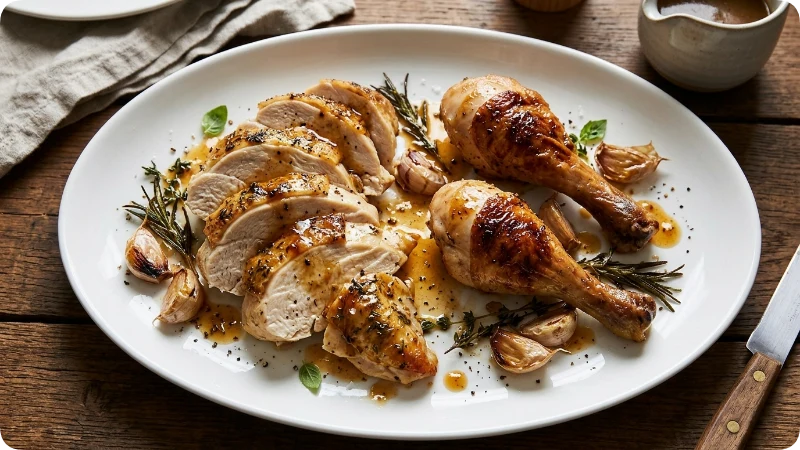
Carve the chicken into drumsticks, thighs, wings, and sliced breasts. Spoon the warm pan drippings directly over the carved pieces, or deglaze the skillet on the stovetop with 1/4 cup of dry white wine or low-sodium chicken stock for 2 minutes to create a quick pan sauce. Serve alongside steamed green beans, roasted root vegetables, or a crisp green salad.
Storage and Food Safety
- Refrigeration: Cool leftover chicken and place it in an airtight container within 2 hours of cooking (or within 1 hour if room temperature exceeds 90°F / 32°C). Refrigerate at or below 40°F (4°C) for up to 3 to 4 days.
- Reheating: Reheat leftover meat in an oven preheated to 350°F (177°C) with a splash of broth in a covered dish until an internal temperature of 165°F (74°C) is reached, or reheat gently in a microwave on medium-high power.
- Freezing: Strip the meat from the bones and store in freezer-safe vacuum bags or airtight containers for up to 3 months. Save the carcass to make homemade chicken stock.
FAQs
Do I need to flip the chicken while roasting?
No. Roasting the chicken breast-side up the entire time ensures the breast skin crisps and browns evenly without tearing from contact with the pan.
Can I roast a chicken without kitchen twine?
Yes. If you do not have kitchen twine, cut a small slit into the loose skin near the cavity opening and tuck the ends of the drumsticks through the slit, or simply roast the bird untrussed. It will cook slightly faster, so start checking the temperature at 40 minutes.
Why is an instant-read thermometer necessary?
Visual checks, such as clear running juices or loose drumsticks, are subjective and do not guarantee safety. A calibrated digital thermometer placed in the thickest part of the inner thigh (avoiding bone) is the only accurate method to verify that the bird has reached the mandatory 165°F (74°C) safety threshold.
Can I make this recipe in a 9×13 baking dish?
Yes, provided the baking dish is oven-safe to 425°F (218°C). Avoid deep metal roasting pans with high sides, which trap moisture and prevent crisping.
Final Summary
This simple roast chicken recipe provides a reliable method for roasting a whole chicken to achieve crisp skin and tender meat. Featuring essential prep techniques, clear seasoning steps, safe internal temperature guidelines, and practical troubleshooting, the guide ensures high-heat roasting success in under two hours with basic kitchen equipment.

Leo Campbell is the founder, recipe developer, and culinary voice behind Recipe Morsil. With nearly a decade of hands-on home cooking and professional baking experience, Leo tests every recipe multiple times to ensure reliable, fail-proof results in real home kitchens. When he’s not fine-tuning spices or testing cook times, he’s helping home cooks build confidence one bite at a time.
Connect with Leo via [Instagram/Email] or explore his verified recipes below.